BIS FMCS Certification for Foreign Manufacturers — Complete Guide to Selling Your Products in India
If you are a manufacturer based outside India and you want to sell your products in the Indian market, BIS FMCS Certification is the route you need. India is one of the fastest-growing consumer markets in the world — but it also has some of the most structured product compliance requirements. Without the right BIS licence, your products simply cannot enter legally.
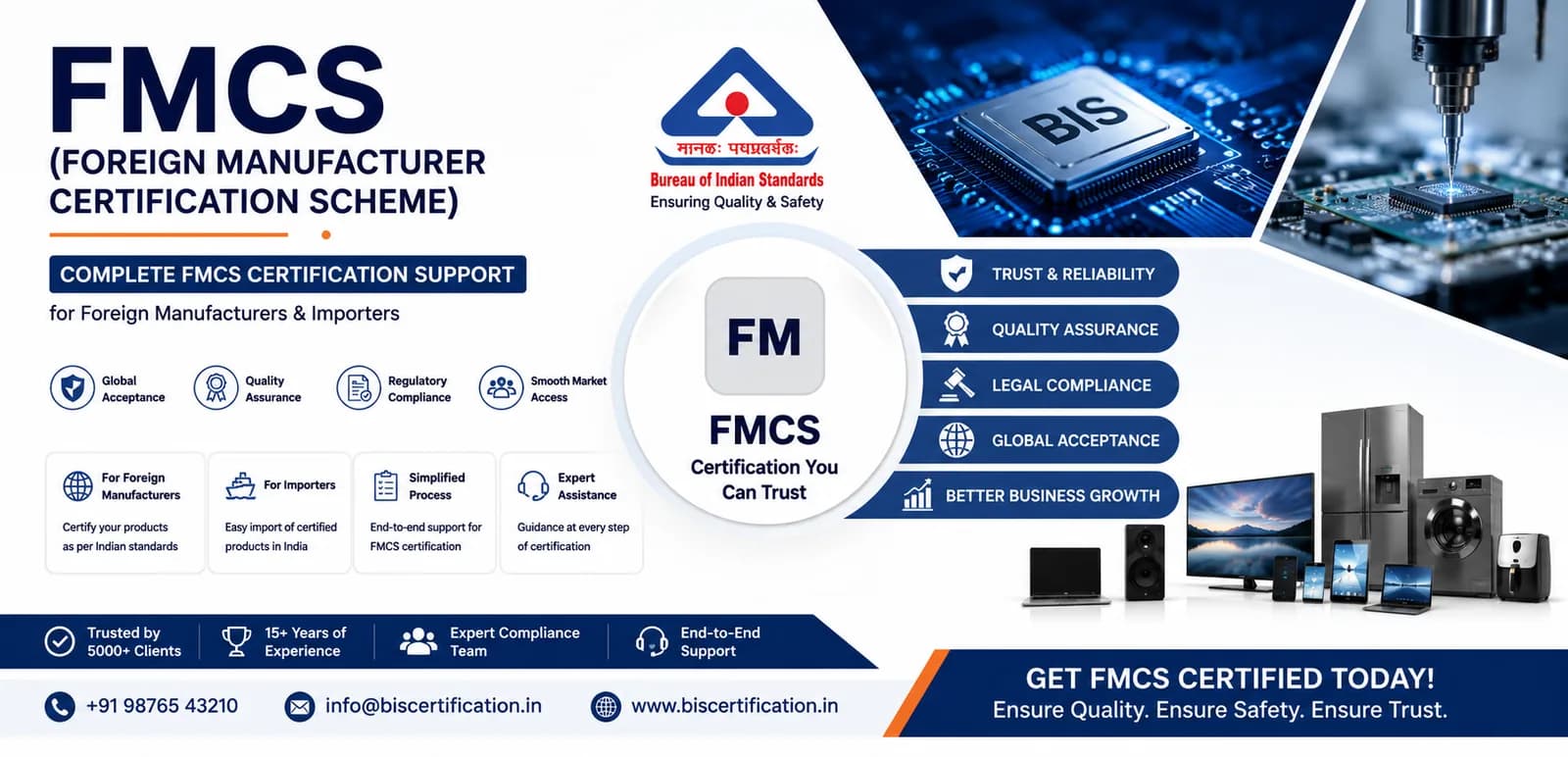
The Bureau of Indian Standards Foreign Manufacturers Certification Scheme — commonly known as BIS FMCS — was designed specifically for international manufacturers who want to certify their products against Indian Standards and gain access to Indian buyers, distributors, and e-commerce platforms.
At Ornate Quality Services, we have been helping foreign manufacturers navigate the BIS FMCS process since 2013. We understand exactly what BIS expects, what the common delays are, and how to get your licence approved without unnecessary back-and-forth.
Already know what you need? Contact our team for a free consultation and get a clear roadmap for your BIS FMCS Certification.
What is BIS FMCS Certification?
BIS FMCS — or the Foreign Manufacturers Certification Scheme — is a product certification programme run by the Bureau of Indian Standards (BIS) that allows manufacturers outside India to obtain a BIS licence for their products.
Under this scheme, foreign manufacturers can apply for certification against the relevant Indian Standard (IS) for their product category. Once the application is approved and the BIS licence is granted, the manufacturer can affix the BIS Standard Mark on their products and legally import and sell them in India.
The scheme operates under the BIS Act, 2016 and follows a structured process that includes document review, product testing at BIS-recognised laboratories, factory inspection at the manufacturing facility, and ongoing surveillance after the licence is granted. FMCS is currently the only official route through which foreign manufacturers can obtain a BIS product certification licence directly — without going through an Indian importer or third-party licence holder.
Why BIS FMCS Certification Matters for Your Business
India's product compliance landscape has changed significantly over the last decade. What was once a market where imported goods could enter with minimal checks is now one of the most actively regulated consumer markets in the world. Here is why BIS FMCS Certification is no longer optional for serious international manufacturers.
Mandatory for Hundreds of Product Categories
The Indian government has notified over 500 product categories under compulsory BIS certification — including electronics, IT products, electrical goods, toys, chemicals, and more. Importing these products without a valid BIS licence is a violation of Indian law. Customs authorities are increasingly checking for BIS compliance at ports of entry, and non-compliant shipments are being held, returned, or destroyed.
Access to India's Growing Consumer Market
India is the world's most populous country and one of its fastest-growing economies. E-commerce platforms like Amazon India, Flipkart, and Meesho require BIS certification for several product categories. Retail chains, government procurement portals like GeM, and institutional buyers all demand valid BIS licences before placing orders. Without FMCS certification, international brands are locked out of these channels.
Direct Brand Ownership of the BIS Licence
One of the most important advantages of FMCS over alternatives is that the BIS licence is issued directly in the name of the foreign manufacturer. This means you retain full control over your brand, your product, and your compliance status — without depending on an Indian importer or agent to hold the licence on your behalf.
Stronger Market Position Against Local Competition
Indian consumers and buyers recognise the BIS Standard Mark as a symbol of product quality and safety. A foreign manufacturer with a valid BIS FMCS licence stands on equal footing with certified Indian manufacturers — and often ahead of uncertified competitors, both domestic and international.
Which Products Require BIS FMCS Certification for Foreign Manufacturers?
BIS FMCS Certification applies to all product categories that are notified under mandatory BIS certification in India. The following are some of the most common product categories for which foreign manufacturers seek FMCS certification.
| Product Category | Common Products | Applicable IS Standard |
|---|---|---|
| Electronics & IT | Laptops, tablets, printers, monitors, set-top boxes | IS 13252, IS 616 |
| Mobile & Wireless Devices | Mobile phones, smart watches, wireless earbuds, routers | IS 13252, IS 616 |
| Power Products | Power banks, chargers, adaptors, UPS, inverters | IS 13252 |
| Electrical Appliances | LED lights, fans, air conditioners, refrigerators | IS 10322, IS 1570 |
| Toys & Baby Products | Toys, baby gear, infant care products | IS 9873, IS 15644 |
| Batteries & Energy | Lithium batteries, dry cell batteries, solar cells | IS 16046, IS 1651 |
| Safety Equipment | Helmets, fire extinguishers, safety footwear | IS 4151, IS 2171 |
| Chemical Products | Disinfectants, household cleaners, certain chemicals | Various IS codes |
This list is indicative and not exhaustive. New product categories are regularly brought under mandatory BIS certification. Our team will confirm the exact IS standard and FMCS applicability for your specific product during your free consultation.
BIS FMCS Certification Process — Step by Step
The BIS FMCS process is more involved than domestic BIS certification because it includes international coordination, factory inspection at the overseas manufacturing facility, and additional documentation requirements. Here is a clear breakdown of every step — and how Ornate Quality Services manages each one for you.
Step 1 — Eligibility Check & Product Assessment
The first step is confirming that your product falls under a notified BIS category and identifying the applicable Indian Standard. We review your product specifications, intended use, and target market to determine the exact certification requirements and the correct FMCS application route.
Step 2 — Appointment of Authorised Indian Representative (AIR)
BIS requires every foreign manufacturer applying under FMCS to appoint an Authorised Indian Representative (AIR). The AIR acts as the official liaison between the foreign manufacturer and BIS in India. Ornate Quality Services can act as your Authorised Indian Representative, or we can help you appoint the right entity based on your business structure in India.
Step 3 — Document Preparation & Application Filing
We prepare your complete FMCS application package including all technical documents, business registration proofs, product specifications, manufacturing process details, quality control plan, and factory layout. The application is filed on the BIS online portal along with the prescribed fee. Getting the documentation right the first time is critical — incomplete or incorrect applications are a leading cause of delays.
Step 4 — Product Testing at BIS-Recognised Laboratory
Product samples must be tested at a BIS-recognised laboratory against the parameters specified in the applicable Indian Standard. For foreign manufacturers, samples can be tested at BIS-recognised labs in India or at internationally accredited laboratories that BIS accepts for specific product categories. We coordinate the complete testing process — from sample selection and shipment logistics to test report submission.
Step 5 — Factory Inspection at Overseas Manufacturing Facility
A team of BIS officials travels to your manufacturing facility outside India to conduct a physical inspection. Ornate prepares a complete inspection readiness report for your facility, conducts a pre-inspection audit, and helps you address every gap before the BIS team arrives. We also coordinate travel and logistics support for the BIS inspection team where required.
Step 6 — BIS Review & Licence Grant
After the factory inspection and testing are completed satisfactorily, BIS reviews all the documentation and inspection findings. If everything is in order, BIS grants the FMCS licence with a unique CM/L number. The licence must be renewed periodically, and BIS conducts ongoing surveillance inspections.
Step 7 — Post-Licence Compliance & Surveillance
After receiving your BIS FMCS licence, you must ensure that every product exported to India carries the BIS Standard Mark with your CM/L number. BIS conducts market surveillance and periodic factory inspections throughout the licence period. Our team provides ongoing compliance support and renewal management so your licence stays current.
BIS FMCS Certification Registration Requirements
Foreign manufacturers applying under the BIS FMCS scheme must meet the following eligibility requirements before applying.
Manufacturing Facility Requirements
- A permanent, owned or leased manufacturing facility with documented production processes
- In-house testing equipment as specified in the relevant Indian Standard — calibrated and functional
- A documented quality management system covering raw material inspection, in-process checks, and finished goods testing
- Qualified technical personnel responsible for product quality and compliance
- Ability to consistently produce products that conform to the applicable Indian Standard
Business & Legal Requirements
- Valid business registration in the country of manufacture
- Product liability insurance (recommended, may be required for specific categories)
- Appointment of an Authorised Indian Representative (AIR) with a valid address in India
- Agreement to allow BIS inspectors to conduct factory visits at any time during the licence period
- Commitment to use the BIS Standard Mark only on products covered under the licence
Not sure whether your facility meets BIS FMCS requirements? We offer a pre-application assessment to identify gaps and help you prepare before filing. Contact us for details.
Documents Required for BIS FMCS Certification
The following documents are required for a BIS FMCS application. All documents must be in English or accompanied by a certified English translation.
| No. | Document | Details |
|---|---|---|
| 1 | Business Registration Certificate | Company incorporation certificate or equivalent from country of origin |
| 2 | Factory Address Proof | Ownership or lease agreement for the manufacturing facility |
| 3 | Product Technical Specifications | Detailed specs, dimensions, materials, ratings, and performance data |
| 4 | Manufacturing Process Flow Chart | Step-by-step diagram of the complete production process |
| 5 | Quality Control Plan | Documented QC procedures — incoming, in-process, and outgoing inspection |
| 6 | In-House Testing Equipment List | Complete list with calibration certificates and test standards |
| 7 | Product Test Reports | Test reports from a BIS-recognised or BIS-accepted international laboratory |
| 8 | AIR Appointment Letter | Signed authorisation letter appointing the Indian Representative |
| 9 | AIR Identity & Address Proof | PAN card, Aadhaar, and address proof of the Authorised Indian Representative |
| 10 | Product Photographs | Clear photographs of the product, packaging, and any existing certification marks |
Document requirements can vary based on the product category and applicable Indian Standard. Our team provides a precise, product-specific document checklist after an initial review of your application.
BIS FMCS Certification Cost — What to Expect
BIS FMCS Certification involves several cost components. Understanding these upfront helps you plan your certification budget without surprises.
BIS Application & Licence Fees
BIS charges a non-refundable application fee at the time of filing, along with an annual licence fee upon grant of the certificate. These fees are set by BIS and vary by product category. Application fees for FMCS typically range from INR 10,000 to INR 50,000 depending on the scheme and product.
Factory Inspection Travel Costs
For overseas factory inspections, the foreign manufacturer is required to bear the travel, accommodation, and daily allowance costs of the BIS inspection team. This is a significant cost component that varies depending on the country of manufacture and the duration of the inspection. We help you plan and manage these costs efficiently, including coordination with BIS for inspection scheduling to minimise travel expenses.
Product Testing Charges
Testing charges are paid to the laboratory and vary by product category and the number of parameters to be tested. For internationally accredited labs, charges can range from USD 500 to USD 5,000+ per sample set.
Professional Service Fees
Ornate Quality Services charges a fixed professional fee covering end-to-end FMCS application management, document preparation, AIR services, inspection support, and post-licence compliance. All fees are quoted transparently upfront. For a complete cost estimate specific to your product, country, and manufacturing setup — contact our team. We will provide a full breakdown at no obligation.
BIS FMCS Licence Validity and Renewal
A BIS FMCS licence is typically granted for a period of one to two years, subject to satisfactory surveillance inspections and continued conformity to the applicable Indian Standard. The exact validity period is determined by BIS based on the product category and the outcome of the initial factory inspection.
Renewal Process
FMCS licence renewal must be initiated before the current licence expires. The renewal process involves submission of updated documents, payment of the renewal fee, and confirmation of continued conformity. BIS may also conduct a factory inspection as part of the renewal process for certain product categories.
Surveillance During Licence Period
BIS conducts market surveillance by purchasing products from retail channels and testing them against the applicable Indian Standard. If a product fails surveillance testing, the manufacturer is required to explain and rectify the non-conformance. Our team monitors your compliance status and ensures you are always prepared for surveillance activity.
Key Benefits of BIS FMCS Certification for Foreign Manufacturers
- Legal market entry — sell products in India without risk of customs clearance issues or seizure
- Direct brand ownership — BIS licence issued in your name, not an intermediary's
- Access to e-commerce — list products on Amazon India, Flipkart, and other major platforms
- Government procurement — eligible to supply to government buyers through GeM and institutional tenders
- Consumer confidence — the BIS Standard Mark is recognised and trusted across India
- Competitive advantage — stand out from uncertified international and domestic competitors
- Long-term market access — licence renewal ensures continuous legal presence in the Indian market
- Protection from enforcement — avoid product seizure, port holds, and legal liability
- Structured compliance — BIS FMCS creates a compliance framework that strengthens your overall quality systems
Penalties for Importing Products Without BIS FMCS Certification
Importing or selling notified products in India without a valid BIS licence is a serious violation under the BIS Act, 2016. Enforcement has increased significantly in recent years, with customs authorities, BIS field officers, and market surveillance teams actively checking compliance.
| Violation | Consequence |
|---|---|
| Importing notified products without BIS licence | Shipment held at customs, refused entry, or destroyed |
| Selling uncertified products in Indian market | Product seizure, penalties up to INR 2,00,000, and possible imprisonment |
| Misuse of BIS Standard Mark | Criminal prosecution under BIS Act with enhanced penalties |
| Repeated violation after first offence | Fine up to INR 5,00,000 and extended legal proceedings |
The cost of getting BIS FMCS certified is always lower than the cost of dealing with customs holds, product destruction, and legal proceedings. Acting proactively is the only sensible approach for any serious international manufacturer targeting the Indian market.
Real Example — How We Helped a Chinese Electronics Manufacturer Get BIS FMCS Certified
A consumer electronics manufacturer based in Shenzhen, China approached Ornate Quality Services after their products were held at a Mumbai customs port for the second time in six months. They were importing LED smart bulbs and Wi-Fi routers — both of which fall under mandatory BIS certification — without a valid BIS licence.
The Challenge
The manufacturer had previously engaged a local Indian importer who had assured them that certification was not required. When BIS enforcement caught up with two shipments, the financial and reputational cost was significant. They needed to get FMCS certified quickly — and correctly — before their next shipment.
What We Did
Our team conducted an emergency assessment of their product range and identified the applicable IS standards for both product categories. We managed the complete FMCS application process — from document preparation and testing coordination to coordinating the BIS factory inspection in Shenzhen and acting as their Authorised Indian Representative throughout.
The Result
Both BIS FMCS licences were granted within five months of engaging Ornate. The manufacturer now imports without disruption, is listed on two major Indian e-commerce platforms, and has since expanded their India-certified product range to include power banks and smart home devices.
Frequently Asked Questions — BIS FMCS Certification
Any manufacturer based outside India who wants to sell products in notified categories in the Indian market needs BIS FMCS Certification. This includes manufacturers from China, South Korea, Taiwan, Germany, the USA, and any other country. If your product falls under a mandatory BIS category and you want to export it to India, FMCS is your route.
Get Your BIS FMCS Certification Now
Ready to enter the Indian market with full BIS compliance? Contact Ornate Quality Services for a free consultation and a clear roadmap for your FMCS certification.