
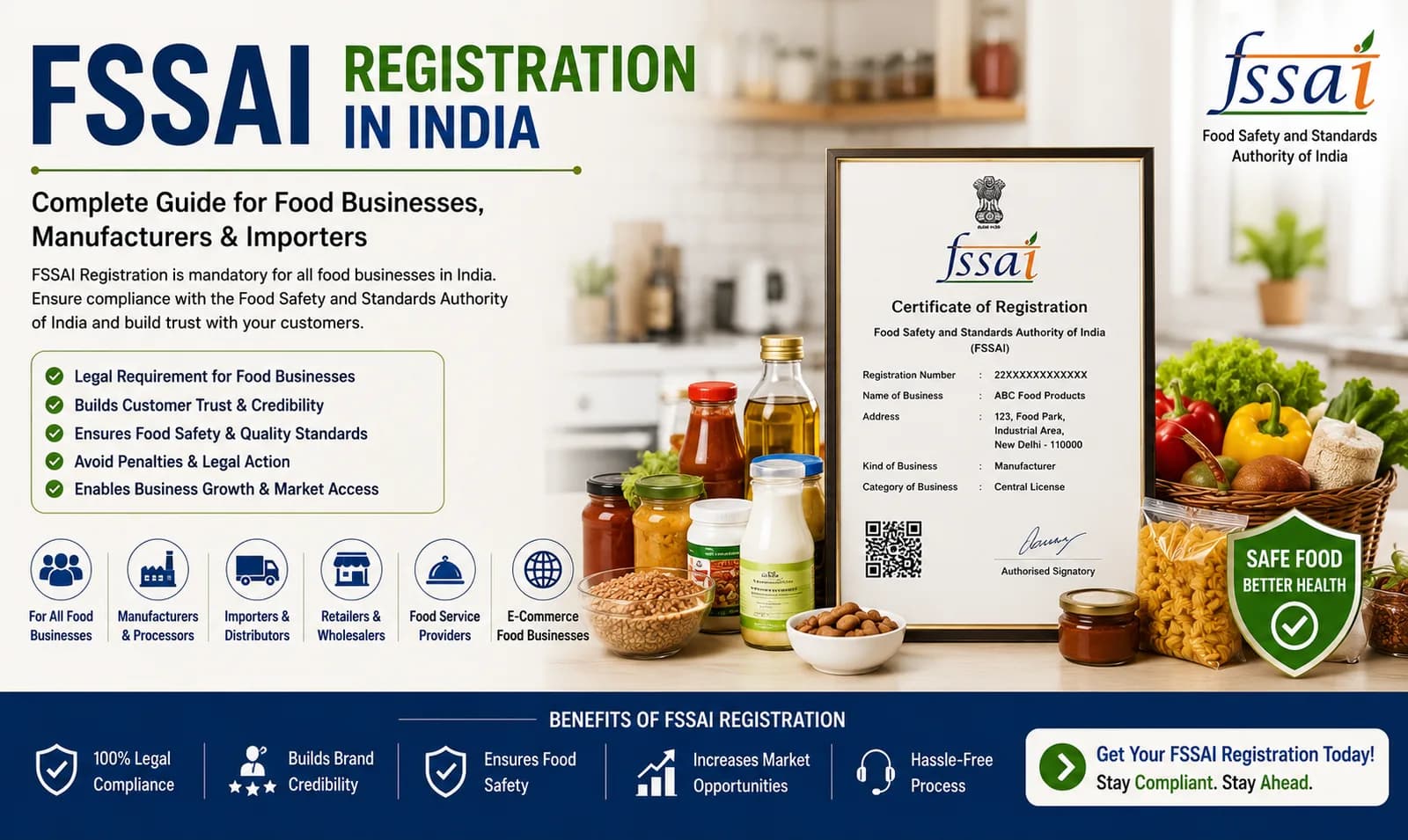
FSSAI Registration in India — Complete Guide for Food Businesses, Manufacturers & Importers
If your business involves food — manufacturing it, processing it, storing it, distributing it, importing it, or selling it — FSSAI Registration is not optional. It is the foundational compliance requirement for every food business in India, and operating without it exposes you to serious legal and financial consequences.
FSSAI stands for Food Safety and Standards Authority of India — the regulatory body established under the Food Safety and Standards Act, 2006, to set standards for food products and regulate their manufacture, storage, distribution, sale, and import. Every food business operator (FBO) in India must obtain a valid FSSAI licence or registration before commencing operations.
At Ornate Quality Services, we help food manufacturers, importers, exporters, traders, and food service businesses obtain their FSSAI Registration or Licence quickly and correctly. In this guide, we cover everything you need to know — what FSSAI registration is, which type applies to you, how the process works, what it costs, and what happens if you operate without it.
Running a food business or planning to start one? Contact our team for a free FSSAI consultation and we will identify the right licence type for your business.
What is FSSAI Registration?
FSSAI Registration — or FSSAI Licence — is the mandatory authorisation issued by the Food Safety and Standards Authority of India to food business operators. It confirms that the FBO has been registered with or licensed by FSSAI and is authorised to carry out food-related business activities in India.
The FSSAI licence number — a 14-digit unique identification number — must be printed on all food product labels, packaging, menus, and other business documents. The first two digits identify the licence type: 1 for Basic Registration, 2 for State Licence, and 3 for Central Licence.
FSSAI operates three levels — Basic Registration for small businesses, State Licence for medium-sized businesses, and Central Licence for large manufacturers, importers, and businesses operating across multiple states. The appropriate level depends on annual turnover, food activity type, and scale of operations.
FSSAI Registration is issued under the Food Safety and Standards (Licensing and Registration of Food Businesses) Regulations, 2011, and is renewable annually or every 1 to 5 years depending on licence type and state jurisdiction.
Why FSSAI Registration Is Essential for Your Food Business
FSSAI Registration is not just a compliance formality — it is the legal foundation of every food business in India.
It Is Legally Mandatory for All Food Business Operators
The Food Safety and Standards Act, 2006 makes FSSAI registration or licensing compulsory for every food business operator in India — regardless of scale, food type, or business structure. Operating without FSSAI registration is a criminal offence under the FSS Act.
E-Commerce Food Sales Require It
Swiggy, Zomato, Amazon Fresh, BigBasket, and every other food delivery and e-commerce platform require a valid FSSAI licence number before a food business can list products or services. Without FSSAI registration, your business cannot operate through organised online food channels in India.
Retail and Distribution Require It
Organised retail chains, supermarkets, wholesalers, and institutional buyers require FSSAI registration documents before onboarding food suppliers. Your FSSAI number must appear on product labels — and buyers check it.
Protects Consumers and Builds Brand Trust
The FSSAI logo on food packaging tells consumers that the product has been produced by a registered food business subject to FSSAI quality and safety standards — building confidence in packaged food markets.
Required for Food Export
Indian food exporters must hold a valid FSSAI Central Licence. Export consignments are checked by customs and the Export Inspection Council (EIC) for FSSAI compliance. Without a valid Central Licence, food export shipments cannot be cleared.
Types of FSSAI Registration — Which One Do You Need?
FSSAI operates three levels of registration and licensing. Identifying the correct type for your business is the most important first step in the FSSAI registration process.
| Factor | Basic Registration | State Licence | Central Licence |
|---|---|---|---|
| Annual Turnover | Up to INR 12 lakh | INR 12 lakh to INR 20 crore | Above INR 20 crore |
| Business Type | Petty food manufacturers, small retailers, hawkers | Medium manufacturers, processors, storage units | Large manufacturers, importers, exporters, multi-state |
| Issuing Authority | State / District Food Safety Officer | State Food Safety Commissioner | Central FSSAI, New Delhi |
| FSSAI Number Prefix | Starts with 1 | Starts with 2 | Starts with 3 |
| Validity | 1 to 5 years | 1 to 5 years | 1 to 5 years |
| Who Typically Needs It | Home bakers, small dhabas, local retailers | Food processors, packaged food makers | Food importers, large manufacturers, exporters |
Importers of food products into India always require a Central Licence — regardless of turnover. This is one of the most common misunderstandings among food importers who apply for a State Licence and then find import shipments blocked at customs. Our team confirms the correct licence type during your free consultation.
Not sure which FSSAI licence type applies to you? Our team assesses your business and confirms the correct registration category before we file anything.
FSSAI Registration Process — Step by Step
The FSSAI registration and licensing process is managed through FSSAI's online portal — FoSCoS (Food Safety Compliance System). The process varies slightly depending on whether you are applying for Basic Registration, State Licence, or Central Licence.
Step 1 — Business Assessment & Licence Type Determination
The first and most important step is confirming the correct type of FSSAI registration or licence for your specific business — based on annual turnover, food activity type, production scale, import/export status, and multi-state operations. Getting this wrong wastes time and money, and for importers can result in shipments held at customs. Our team conducts a thorough business assessment before proceeding to the application.
Step 2 — Document Preparation
We prepare your complete FSSAI application documentation including identity and address proof, business registration documents, food safety management plan, list of food products, layout plan of premises, and all other documents required for your specific licence type and food category. Document requirements vary significantly between Basic Registration, State Licence, and Central Licence.
Step 3 — FoSCoS Portal Application Filing
The application is filed on FSSAI's FoSCoS portal. We create the applicant's portal account, complete the application form with all required details, upload supporting documents, and submit the application along with the prescribed fee. Upon submission, an application reference number is generated for tracking.
Step 4 — Application Review & Inspection (If Required)
For Basic Registration, FSSAI typically processes applications through document review without physical inspection. For State Licence and Central Licence applications, a Food Safety Officer may conduct a physical inspection of premises to verify facility, storage conditions, hygiene practices, and food safety infrastructure. Our team prepares you comprehensively for inspection.
Step 5 — Grant of FSSAI Licence
Once the application review — and inspection, where applicable — is satisfactorily completed, FSSAI grants the licence and issues the FSSAI Registration Certificate including the 14-digit FSSAI number, business details, products covered, and validity period. The FSSAI number must be printed on all food product labels and packaging from the date of licence grant.
Step 6 — Label Compliance Review
FSSAI has detailed labelling requirements under the Food Safety and Standards (Labelling and Display) Regulations, 2020. Our team reviews your product labels against FSSAI requirements — FSSAI licence number, ingredients, nutritional information, allergens, net quantity, dates, and other mandatory declarations — before products go to market.
Step 7 — Annual Return Filing & Renewal
FSSAI-licensed businesses must file an Annual Return on the FoSCoS portal before 31st May each year. FSSAI licences must also be renewed before expiry. Our team manages both annual returns and licence renewals proactively — sending reminders and handling complete renewal applications.
FSSAI Registration Requirements for Food Businesses
The eligibility and infrastructure requirements for FSSAI registration vary by licence type.
For Basic Registration
- Valid identity and address proof of the food business operator
- Address proof of the food business premises
- Annual turnover below INR 12 lakh
- Business registration — GST, Shop Act, or equivalent
- List of food products to be manufactured, stored, or sold
For State Licence
- All Basic Registration requirements plus annual turnover between INR 12 lakh and INR 20 crore
- Layout plan of the food processing or storage premises
- List of equipment and machinery used in food processing
- Food safety management system documentation
- Source of water supply confirmation for food processing units
- NOC from municipality or local body (for new premises)
For Central Licence
- All State Licence requirements plus annual turnover above INR 20 crore, or importer / exporter status
- Import Export Code (IEC) for importers and exporters
- Detailed product list with applicable FSSAI food safety standards
- Certificate of incorporation for companies
- Food safety management plan covering HACCP or equivalent
For food importers specifically, a Central Licence is mandatory regardless of turnover. The Central Licence for importers must be linked to the IEC and covers all food products imported through Indian ports.
Documents Required for FSSAI Registration
The following documents are required for FSSAI registration and licensing. Requirements vary by licence type — documents marked in details as State & Central Licence are required for those licence types only.
| No. | Document | Details |
|---|---|---|
| 1 | Identity Proof | Aadhaar card, PAN card, or passport of the applicant / authorised signatory |
| 2 | Address Proof of Business | Rental agreement, electricity bill, or property ownership document for premises |
| 3 | Business Registration Certificate | GST registration, company incorporation, partnership deed, or Shop Act licence |
| 4 | PAN Card | PAN of business entity or individual proprietor |
| 5 | Food Product List | Complete list of all food products to be manufactured, processed, stored, or sold |
| 6 | Premises Layout Plan | Scaled layout drawing of the food processing, manufacturing, or storage facility (State & Central Licence) |
| 7 | Equipment List | List of all machinery and equipment used in food processing or manufacturing (State & Central Licence) |
| 8 | Water Test Report | Water quality test report from a NABL-accredited lab for food processing units (State & Central Licence) |
| 9 | Food Safety Management Plan | HACCP or equivalent food safety plan covering hazard analysis and control measures (State & Central Licence) |
| 10 | IEC Certificate (Importers) | Mandatory for food importers applying for Central Licence |
Our team provides a precise, licence-type-specific document checklist after reviewing your business details. For food manufacturers and importers with complex product portfolios, we manage all documentation systematically.
FSSAI Registration Cost in India
FSSAI registration fees are set by FSSAI and vary by licence type, validity period, and state.
Government Fee — Basic Registration
The government fee for FSSAI Basic Registration is INR 100 per year. For a 5-year registration, the fee is INR 500. Basic Registration is the most affordable food business compliance step in India.
Government Fee — State Licence
State Licence fees vary by state and by the type and scale of food business activity. Fees typically range from INR 2,000 to INR 5,000 per year depending on the state and category. A 5-year licence reduces the per-year cost significantly.
Government Fee — Central Licence
Central Licence fees are INR 7,500 per year for most food business categories, including food importers. Fees for food manufacturers with high production capacity may be higher based on FSSAI's fee schedule.
Professional Service Fees
Ornate Quality Services charges a professional fee for end-to-end FSSAI registration management — from licence type determination and document preparation to portal filing, inspection support, label compliance review, and annual return management. All fees are quoted transparently before we begin.
For a precise cost estimate including government fees and professional service fees for your specific food business — contact our team for a free consultation.
FSSAI Registration Validity and Renewal
FSSAI licences and registrations are issued for a period of 1 to 5 years, at the applicant's choice. A 5-year licence or registration is generally more cost-effective and reduces the administrative burden of frequent renewals.
Renewal Process
FSSAI licence renewal must be applied for at least 30 days before the expiry date on the FoSCoS portal. Renewal applications filed late are subject to a penalty. Licences that lapse without renewal require a fresh application. Our team sends renewal reminders 60 days before expiry and manages the complete renewal process.
Annual Return Filing
All FSSAI-licensed businesses (State and Central Licence holders) must file an Annual Return on the FoSCoS portal before 31st May each year. Failure to file the annual return attracts penalties under the FSS Act.
Change of Details
Any change in the food business — including change of address, addition of new food products, change of business name, or addition of new premises — must be intimated to FSSAI through a modification application on the FoSCoS portal.
Key Benefits of FSSAI Registration for Your Food Business
- Legal compliance — operate your food business without risk of enforcement action, seizure, or prosecution
- E-commerce access — list food products on Swiggy, Zomato, Amazon Fresh, BigBasket, and all online food platforms
- Retail onboarding — supply to supermarkets, organised retail chains, and institutional food buyers
- Export clearance — Central Licence enables export of food products through Indian ports
- Consumer trust — FSSAI logo on packaging builds buyer confidence in food safety and quality
- Brand credibility — FSSAI registration signals a professional, compliant food business
- GeM portal — required for supplying food products to government institutions through GeM
- Investor confidence — FSSAI compliance is a basic due diligence requirement for food business funding
- Protection from liability — registered food businesses demonstrate regulatory compliance, reducing product liability exposure
Penalties for Operating Without FSSAI Registration
The Food Safety and Standards Act, 2006 prescribes stringent penalties for food businesses operating without FSSAI registration or licence. Enforcement is conducted by Food Safety Officers at both state and central level.
| Violation | Penalty |
|---|---|
| Operating food business without FSSAI registration | Imprisonment up to 6 months and/or fine up to INR 5 lakh |
| Manufacturing or selling unsafe food | Imprisonment up to 7 years and fine up to INR 10 lakh for serious cases |
| Selling food with false or misleading labels | Fine up to INR 3 lakh and product recall |
| Failure to file Annual Return | Penalty of INR 100 per day of delay |
| Selling food after licence expiry | Treated as operating without licence — same penalties as above |
FSSAI enforcement has strengthened significantly in recent years. Food Safety Officers conduct surprise inspections, and e-commerce platforms are increasingly required to verify FSSAI compliance of their food seller partners.
Real Example — How We Helped a Mumbai Food Importer Get FSSAI Central Licence in 3 Weeks
A Mumbai-based company that imported packaged food products — including health supplements, snack foods, and packaged beverages from the USA and Europe — approached Ornate Quality Services after their shipment of imported health supplements was held at Mumbai port by customs for missing FSSAI compliance documentation.
The Challenge
The company had been operating with a State Licence obtained when they were a smaller operation and had expanded into importing without realising that food importers require a Central Licence regardless of turnover. Their State Licence was not accepted at customs, the shipment was held, and storage charges were accumulating daily.
What We Did
Our team immediately confirmed that a FSSAI Central Licence was required. We prepared the complete Central Licence application — including IEC, full product list with applicable FSSAI standards, food safety management plan, and all required business documents — and filed it on an expedited basis on the FoSCoS portal. We also prepared a letter of explanation for customs demonstrating that a Central Licence application was actively in progress.
The Result
The FSSAI Central Licence was granted in 3 weeks. The customs hold was resolved, and the shipment was cleared. The company now operates with a valid Central Licence covering all import categories and verifies every new product category before the first shipment departs from the origin country.
Frequently Asked Questions — FSSAI Registration
Yes. Home-based food businesses — including home bakers and cottage food producers — require FSSAI Basic Registration if annual turnover is below INR 12 lakh. The FSS Act applies to all food business operators regardless of where they operate. Food delivery platforms commonly require an FSSAI number during seller onboarding.
Get Expert Assistance for FSSAI Registration
Need help with FSSAI licence type selection, FoSCoS filing, inspection preparation, label compliance, or annual returns? Connect with Ornate Quality Services for complete support.