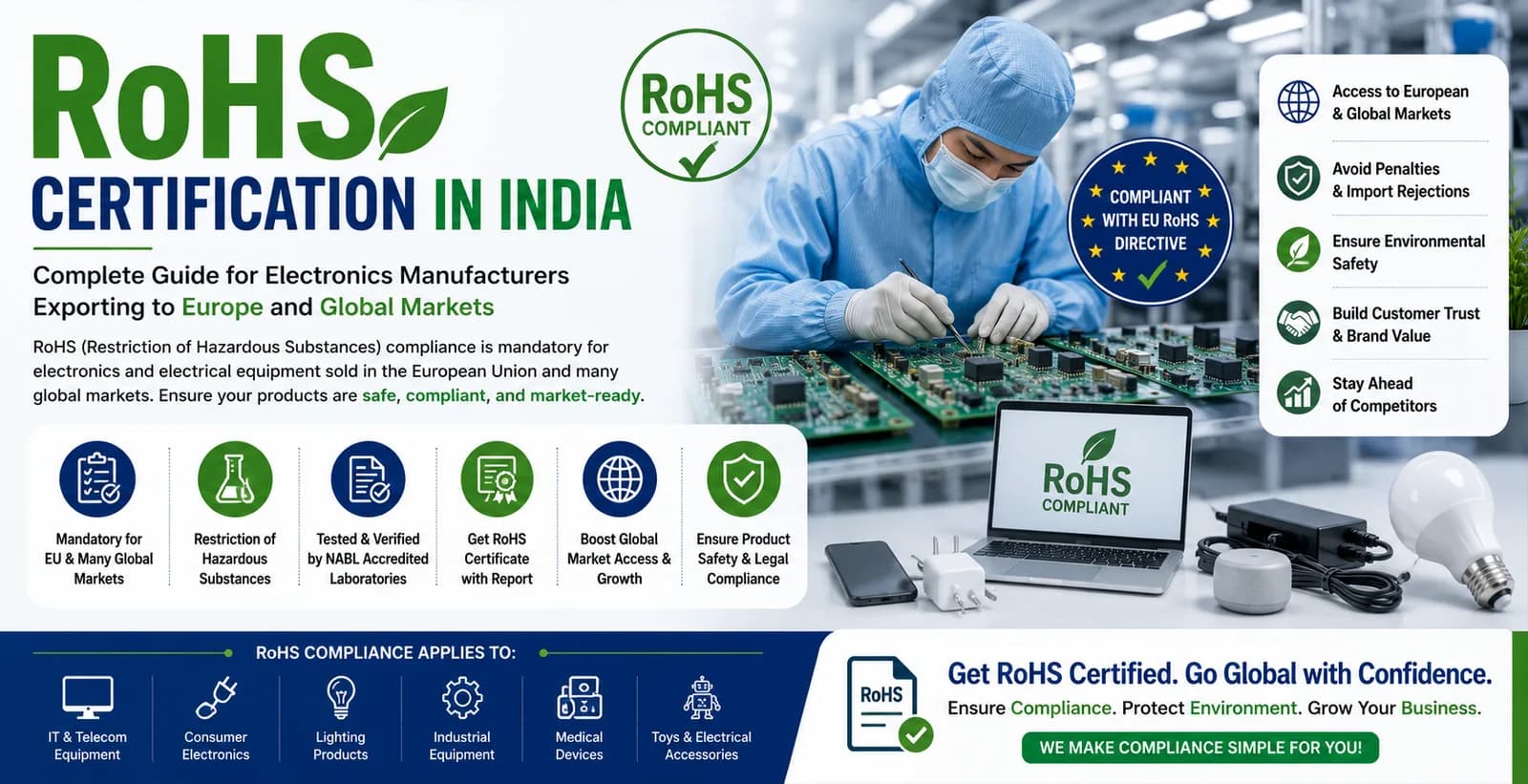
RoHS Certification in India — Complete Guide for Electronics Manufacturers Exporting to Europe and Global Markets
If you manufacture electronic or electrical equipment and want to sell it in Europe — or supply components to manufacturers who do — RoHS Certification is a compliance requirement you cannot overlook. The Restriction of Hazardous Substances Directive restricts the use of specific hazardous materials in electrical and electronic equipment sold in the European Union and several other markets worldwide.
RoHS compliance is not just a European requirement anymore. Countries across Asia, the Americas, and the Middle East have adopted RoHS-equivalent regulations — making RoHS Certification a globally relevant compliance standard for any Indian manufacturer of electronic products targeting international markets. It is also increasingly required by global supply chains, multinational buyers, and corporate procurement teams.
At Ornate Quality Services, we help Indian electronics manufacturers, component suppliers, and importers achieve RoHS compliance and certification — from initial substance testing and documentation to full compliance declaration management. In this guide, we cover everything you need to know about RoHS Certification — what it is, which products it covers, how compliance is achieved, and what it costs.
Exporting electronics to Europe or supplying multinational buyers? Contact our team for a free RoHS compliance consultation and find out where your products stand.
What is RoHS Certification?
RoHS stands for Restriction of Hazardous Substances. The RoHS Directive — formally EU Directive 2011/65/EU (RoHS 2), amended by EU Directive 2015/863/EU (RoHS 3) — is a European Union regulation that restricts the use of specific hazardous substances in electrical and electronic equipment (EEE) sold in the EU market. It is closely linked to CE Marking requirements.
RoHS restricts ten hazardous substances — Lead (Pb), Mercury (Hg), Cadmium (Cd), Hexavalent Chromium (Cr VI), Polybrominated Biphenyls (PBB), Polybrominated Diphenyl Ethers (PBDE), DEHP, BBP, DBP, and DIBP — to maximum concentration values in homogeneous materials within products.
RoHS Certification — or RoHS compliance declaration — is the process by which a manufacturer tests their products and materials, documents compliance, and issues a Declaration of Conformity confirming that the product meets all RoHS requirements. Products that are RoHS compliant and CE marked can display the CE mark on their packaging.
RoHS compliance is self-declared — there is no single RoHS certificate issued by a government body. Manufacturers are responsible for testing their products, documenting compliance, and maintaining technical files that demonstrate conformity with the RoHS Directive.
Why RoHS Certification Matters for Indian Electronics Manufacturers
RoHS compliance has evolved from a purely European regulatory requirement into a global baseline standard for responsible electronics manufacturing.
Mandatory for EU Market Entry
RoHS compliance is mandatory for all electrical and electronic equipment sold in the European Union. Products found non-compliant during EU market surveillance are subject to recall, market withdrawal, and significant financial penalties. RoHS compliance documentation is a non-negotiable prerequisite for Indian manufacturers targeting European distributors, retailers, or e-commerce platforms.
Required by Global Supply Chains
Multinational electronics companies require RoHS compliance from all component and sub-assembly suppliers. If you manufacture PCBs, electronic components, cables, connectors, or any other part that goes into finished electronics products, buyers' procurement teams will ask for RoHS compliance certificates and test reports as a standard supplier qualification requirement.
Adopted by Multiple Countries Beyond the EU
RoHS-equivalent regulations have been adopted by China, the United Kingdom, South Korea, Japan, Turkey, India (E-Waste Rules reference RoHS-equivalent standards), and several other countries. EU RoHS compliance creates a baseline that supports market access in multiple countries simultaneously.
Environmental and ESG Commitment
RoHS compliance demonstrates a manufacturer's commitment to responsible environmental practices. As ESG reporting becomes standard for corporate buyers and investors, RoHS certification is increasingly cited as evidence of environmental responsibility in supply chain due diligence.
Competitive Advantage with International Buyers
Indian electronics manufacturers who hold RoHS compliance documentation stand out from competitors who cannot demonstrate substance compliance. In competitive tender situations, RoHS certification often makes the difference between winning and losing a supply contract with a multinational customer.
Which Products Require RoHS Certification?
RoHS applies to all electrical and electronic equipment (EEE) sold in covered markets. Under RoHS 3, the scope has been extended to cover virtually all categories of EEE.
| Product Category | Common Products | Key Restricted Substances Concern |
|---|---|---|
| Consumer Electronics | Mobile phones, laptops, tablets, TVs, audio equipment | Lead in solder, cadmium in batteries, phthalates in cables |
| Large Household Appliances | Refrigerators, washing machines, dishwashers, air conditioners | Lead in PCBs, mercury in switches, hexavalent chromium |
| Small Household Appliances | Toasters, irons, hair dryers, vacuum cleaners | Lead in solder joints, cadmium in contacts |
| IT & Telecom Equipment | Computers, printers, servers, networking equipment | Lead in solder, PBBs in plastics, phthalates |
| Lighting Equipment | LED lights, fluorescent lamps, control gear | Mercury in lamps, lead in solder |
| Electronic & Electrical Tools | Power tools, electric drills, sewing machines | Lead, cadmium, hexavalent chromium |
| Medical Devices | Non-implantable medical devices, in-vitro diagnostics | Lead in PCBs, cadmium in sensors |
| Electronic Components | PCBs, cables, connectors, capacitors, resistors | Lead in solder, cadmium, phthalates |
| Monitoring & Control Equipment | Industrial sensors, data loggers, control panels | Lead in solder, mercury in sensors |
RoHS 3 has significantly expanded the product scope — covering almost all categories of EEE with limited exemptions. If your product contains electrical components or circuits and is intended for sale in covered markets, RoHS compliance almost certainly applies. Our team will confirm RoHS applicability for your specific product during your free consultation.
RoHS Compliance & Certification Process — Step by Step
RoHS compliance is achieved through a structured process of substance identification, testing, documentation, and declaration. Unlike certifications involving a third-party certificate, RoHS compliance is self-declared — making the quality of the manufacturer's own compliance process the critical factor.
Step 1 — Product Scope Assessment
The first step is confirming that your product falls within the scope of the RoHS Directive and identifying any applicable exemptions. Our team conducts a scope assessment — confirming applicability, identifying relevant exemptions, and establishing the compliance baseline before testing begins.
Step 2 — Bill of Materials (BOM) Review & Substance Mapping
A complete Bill of Materials review is the foundation of RoHS compliance. Every material, component, and sub-assembly must be assessed for restricted substances. Our team conducts a systematic BOM review — identifying components that may contain restricted substances and requesting supplier declarations and test data. Where supplier data is unavailable, we identify components requiring physical testing.
Step 3 — Laboratory Testing
Components that cannot be confirmed compliant through supplier declarations must be physically tested at an accredited laboratory. RoHS testing typically uses XRF screening followed by ICP-OES or other destructive analysis for confirmation. We coordinate testing at NABL-accredited or internationally accredited laboratories to IEC 62321 series standards.
Step 4 — Supplier Compliance Management
For products with complex supply chains, managing supplier RoHS compliance is an ongoing process. Suppliers must provide material declarations in IPC-1752A or IEC 62474 format. Our team helps manufacturers establish a supplier compliance management process — including questionnaire templates, declaration formats, and systematic maintenance of compliance data.
Step 5 — Technical Documentation Preparation
RoHS compliance requires a complete technical documentation package — BOM with substance compliance data, supplier declarations, laboratory test reports, exemption justifications, and product-level assessment. The technical documentation must be maintained and made available to EU market surveillance authorities upon request.
Step 6 — Declaration of Conformity (DoC)
The manufacturer must issue a Declaration of Conformity confirming RoHS compliance. For products requiring CE Marking, the RoHS DoC is typically incorporated into the CE Declaration of Conformity. Our team drafts the RoHS Declaration of Conformity in the correct format and advises on CE Marking integration where applicable.
Step 7 — Ongoing Compliance Monitoring
RoHS compliance must be maintained throughout the product lifecycle. Component changes, new suppliers, updated formulations, and Directive amendments can all affect compliance status. Our team provides ongoing compliance monitoring — ensuring your RoHS documentation stays current as your products and supply chain evolve.
RoHS Compliance Requirements for Manufacturers
RoHS compliance requires manufacturers to meet the following requirements for all covered electrical and electronic equipment.
Restricted Substance Limits
The RoHS Directive specifies maximum concentration values for each restricted substance in homogeneous materials within the product:
- Lead (Pb) — maximum 0.1% by weight (1000 ppm)
- Mercury (Hg) — maximum 0.1% by weight (1000 ppm)
- Cadmium (Cd) — maximum 0.01% by weight (100 ppm)
- Hexavalent Chromium (Cr VI) — maximum 0.1% by weight (1000 ppm)
- Polybrominated Biphenyls (PBB) — maximum 0.1% by weight (1000 ppm)
- Polybrominated Diphenyl Ethers (PBDE) — maximum 0.1% by weight (1000 ppm)
- DEHP, BBP, DBP, DIBP (Phthalates) — each maximum 0.1% by weight (1000 ppm)
Documentation Requirements
- Complete Bill of Materials with substance compliance data for all components
- Supplier Declarations of Conformity in standard format (IPC-1752A or IEC 62474)
- Laboratory test reports for components tested by physical analysis
- Technical file documenting the complete RoHS compliance assessment
- Declaration of Conformity signed by the manufacturer or authorised representative
Not sure which components in your product require RoHS testing? Our team conducts a free preliminary BOM review and identifies testing priorities. Contact us to get started.
Documents Required for RoHS Certification
The following documents form the core of the RoHS technical file. These must be maintained by the manufacturer and made available to market surveillance authorities upon request.
| No. | Document | Details |
|---|---|---|
| 1 | Bill of Materials (BOM) | Complete list of all materials, components, and sub-assemblies in the product |
| 2 | Supplier Declarations of Conformity | RoHS compliance declarations from all component and material suppliers |
| 3 | Material Data Sheets | Technical data sheets confirming material composition for all critical components |
| 4 | Laboratory Test Reports | XRF screening and ICP-OES or equivalent test reports for physically tested components |
| 5 | Product Substance Assessment | Overall RoHS compliance assessment document covering all restricted substances |
| 6 | Exemption Justification | Technical justification for any exemptions claimed under the RoHS Directive |
| 7 | Declaration of Conformity | Signed DoC confirming product compliance with RoHS Directive 2011/65/EU |
| 8 | Business Registration Certificate | Company incorporation certificate or equivalent |
| 9 | Product Photographs | Clear photographs of product, labelling, and RoHS compliance marking |
| 10 | Change Control Records | Records of any component or material changes and their impact on RoHS compliance |
Our team prepares and manages the complete RoHS technical documentation package — ensuring all documents meet the requirements of EU market surveillance authorities and are ready for inspection at any time.
RoHS Certification Cost for Indian Manufacturers
RoHS compliance costs depend on the complexity of the product, the number of components requiring physical testing, and the state of the manufacturer's existing supply chain compliance data.
Laboratory Testing Charges
XRF screening is relatively affordable, typically costing INR 500 to INR 2,000 per sample. Confirmatory chemical analysis (ICP-OES or equivalent) is typically INR 3,000 to INR 10,000 per sample per substance group. For a product with 20 to 50 components requiring physical testing, total testing costs can range from INR 50,000 to INR 3,00,000.
Supplier Compliance Management
For manufacturers with complex supply chains, supplier compliance management — including supplier questionnaires, declaration review, and follow-up — is primarily a time and resource cost. Our team manages this process efficiently, reducing the internal resource burden.
Technical Documentation Preparation
Preparing a complete RoHS technical file requires regulatory expertise and significant time. Ornate Quality Services charges a professional fee for the complete RoHS compliance service, quoted based on product complexity and the number of components requiring assessment.
Ongoing Compliance Monitoring
Our team offers an annual RoHS compliance monitoring service — covering component change assessments, supplier declaration updates, and documentation maintenance — at a fixed annual retainer fee.
For a precise RoHS certification cost estimate for your specific product and supply chain — contact our team for a free consultation.
RoHS Compliance Validity and Ongoing Maintenance
RoHS compliance does not have a fixed validity period like a product certification. The Declaration of Conformity remains valid as long as the product's composition — and all components and materials within it — remains unchanged and compliant with the current version of the RoHS Directive.
When RoHS Compliance Must Be Re-evaluated
RoHS compliance must be re-evaluated whenever a significant change is made to the product — including component substitution, new material sources, updated supplier formulations, or manufacturing process changes affecting material composition. Re-evaluation is also required when the RoHS Directive is amended.
RoHS Directive Updates
The European Commission periodically reviews the RoHS Directive — adding new restricted substances, updating exemptions, and expanding product scope. Our team monitors EU RoHS regulatory developments and proactively advises clients when changes may affect their existing compliance declarations.
Substance Exemption Renewals
Some RoHS exemptions have time-limited validity and must be renewed by the European Commission. When an exemption expires without renewal, manufacturers relying on that exemption must find alternative compliant solutions. Our team tracks exemption expiry dates relevant to our clients' products.
Key Benefits of RoHS Certification for Indian Manufacturers
- EU market access — mandatory for selling EEE in all 27 EU member states and EEA countries
- Global supply chain access — meet RoHS requirements of multinational electronics OEMs and contract manufacturers
- Multiple market compliance — EU RoHS compliance supports access to UK, China, South Korea, and other RoHS-equivalent markets
- CE Marking prerequisite — RoHS compliance is required for CE Marking of most electrical and electronic products
- ESG credentials — demonstrates commitment to hazardous substance reduction and responsible manufacturing
- Buyer confidence — RoHS documentation reduces buyer risk assessment burden and speeds up supplier qualification
- Export competitiveness — RoHS-certified Indian manufacturers compete on equal terms with European and Asian suppliers
- Legal protection — documented RoHS compliance provides protection in the event of EU market surveillance action
- Future-proofing — early RoHS compliance builds the supply chain transparency infrastructure needed for REACH and other chemical regulations
Consequences of RoHS Non-Compliance in European Markets
RoHS enforcement in EU member states varies by country but has become significantly more active in recent years. The consequences of placing non-compliant products on the European market are serious.
| Violation | Consequence |
|---|---|
| Selling non-RoHS compliant EEE in the EU | Product withdrawal from market, import refusal at EU customs |
| False or misleading RoHS compliance declaration | Financial penalties — up to EUR 50,000+ in some EU member states |
| Product found non-compliant during surveillance | Mandatory recall, corrective action, and public notification across EU |
| Failure to maintain RoHS technical documentation | Administrative penalties and potential criminal liability for company directors |
| Repeated violations | Market ban, enhanced penalties, and reputational damage across EU market |
EU market surveillance authorities share compliance information across member states through the RAPEX rapid alert system. A RoHS non-compliance finding in one EU country is immediately communicated to all other member states — triggering enforcement action across all 27 EU markets and associated EEA countries simultaneously.
Real Example — How We Helped a Pune Electronics Manufacturer Achieve RoHS Compliance for European Export
A Pune-based manufacturer of industrial power supplies and control panels approached Ornate Quality Services after losing a significant European OEM contract. The OEM's procurement team had requested RoHS compliance documentation as part of a routine supplier qualification audit, and the manufacturer had been unable to provide anything beyond a self-declaration without supporting test data or a complete technical file.
The Challenge
The manufacturer had been producing power supplies for eight years without formal RoHS compliance documentation — using components from multiple Indian and Chinese suppliers who had provided basic compliance statements but no standardised material declarations or test data. The European OEM's compliance team found the supplier declarations insufficient to support a valid RoHS compliance assessment.
What We Did
Our team conducted a complete BOM review of three main product lines — covering 340 unique components. We categorised components by RoHS risk level and identified 45 requiring physical XRF screening and 12 requiring confirmatory chemical analysis. We coordinated testing at a NABL-accredited laboratory, managed supplier declaration collection for all 340 components, and prepared the complete RoHS technical file. We also identified two non-compliant components and worked with the manufacturer to find compliant replacements.
The Result
Full RoHS compliance was achieved for all three product lines within 14 weeks. The OEM contract was reinstated, and the manufacturer now has a documented RoHS compliance programme covering their complete product range. They have since expanded their European customer base — with RoHS documentation as a standard part of their supplier qualification package.
Frequently Asked Questions — RoHS Certification
No, but they are closely related. RoHS compliance is one of the requirements for CE Marking of applicable electrical and electronic products. CE Marking covers multiple EU Directives simultaneously — including LVD, EMC, and RoHS. A CE-marked EEE product must be RoHS compliant. For Indian manufacturers exporting EEE to Europe, both RoHS compliance and CE Marking are typically required.
Get Expert Assistance for RoHS Certification
Need help with BOM review, substance testing, supplier compliance management, technical documentation, or Declaration of Conformity? Connect with Ornate Quality Services for complete RoHS compliance support.