CE Certification for Indian Manufacturers — Complete Guide to Exporting Products to Europe
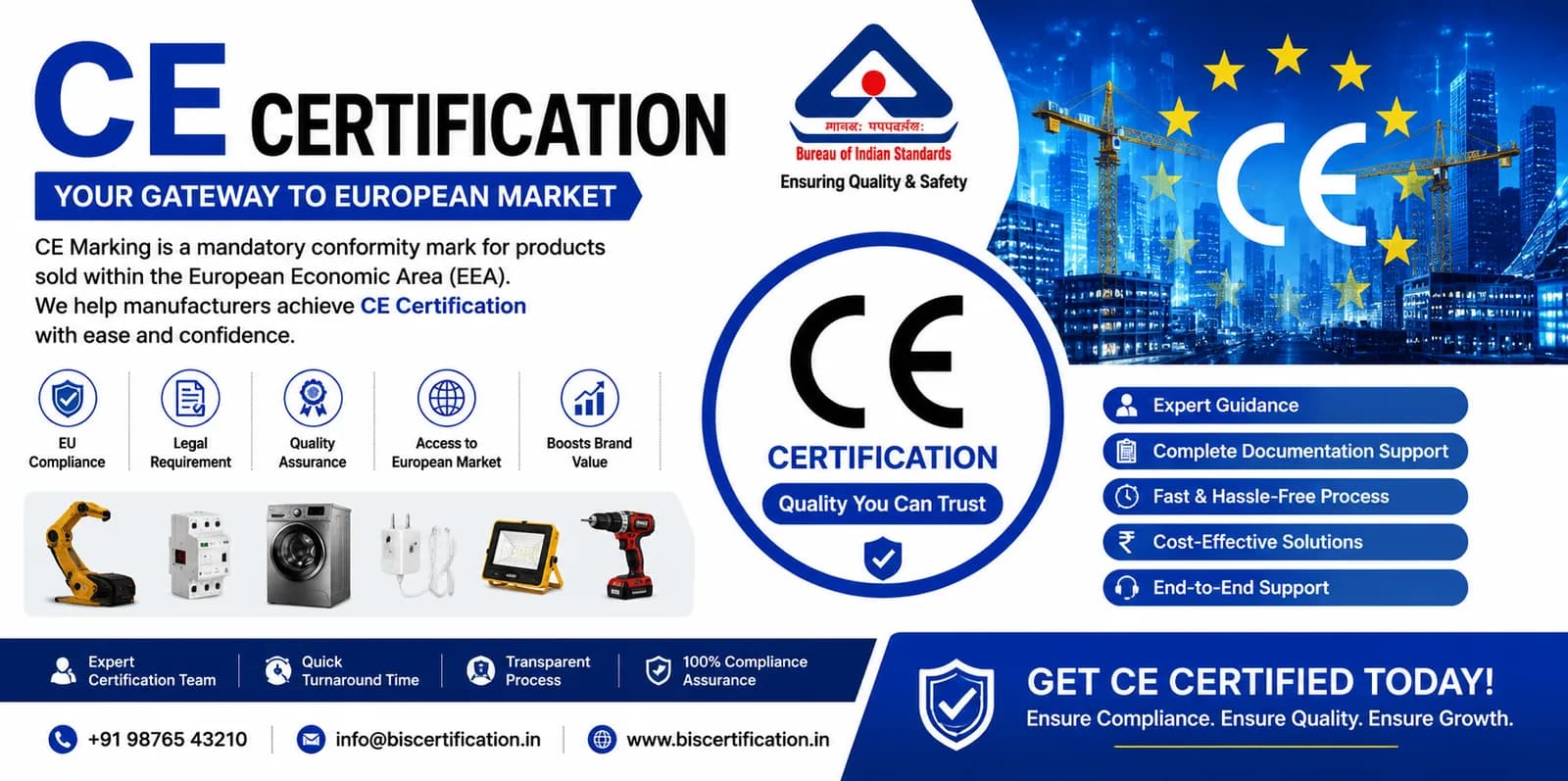
If you are an Indian manufacturer looking to sell your products in Europe, CE Marking is not optional — it is the law. The CE Mark is a mandatory conformity marking for products sold in the European Economic Area (EEA), and it tells regulators, buyers, and consumers that your product meets all applicable European health, safety, and environmental requirements.
CE stands for Conformité Européenne — French for European Conformity. The marking is not a quality endorsement or a product standard in itself. It is a manufacturer's declaration that the product complies with all relevant EU Directives and Regulations for its category. Without the CE Mark, your product cannot legally enter or be sold in any of the 30 EEA member countries.
At Ornate Quality Services, we help Indian manufacturers obtain CE Certification for a wide range of product categories — from electronics and electrical equipment to machinery, medical devices, toys, and personal protective equipment. This guide explains everything you need to know about CE Marking — what it is, which products need it, how the process works, and what it costs.
Planning to export to Europe? Contact our team for a free CE Marking consultation and get a clear roadmap for your product's European market entry.
What is CE Certification?
CE Marking is a mandatory conformity assessment marking required for products sold within the European Economic Area (EEA) — which includes all 27 EU member states plus Iceland, Liechtenstein, and Norway. The CE Mark signifies that a product has been assessed against all applicable EU Directives or Regulations and found to comply with their essential health, safety, and environmental protection requirements.
For Indian manufacturers, CE Certification is the process of demonstrating that a product meets all applicable European requirements — through technical documentation, testing, conformity assessment, and in some cases, independent third-party verification by a Notified Body.
The CE Mark is not a single certificate from a single body — it is a self-declaration of conformity backed by technical evidence. The manufacturer (or their Authorised Representative in the EU) is responsible for preparing a Technical File, issuing a Declaration of Conformity, and affixing the CE Mark.
Some high-risk categories require third-party assessment by a Notified Body. Others allow self-certification provided all requirements are met. Our team will confirm the correct conformity assessment route for your product.
Why CE Certification Matters for Indian Exporters
Mandatory for European Market Entry
CE Marking is a legal requirement for products in notified categories sold in the EEA. Products without the CE Mark are illegal to sell, distribute, or even display for sale. Enforcement by customs and market surveillance is active, and non-compliance can lead to import refusals, recalls, and liability.
Access to 30 European Countries with One Marking
One CE-marked product can be legally sold across all 30 EEA member countries — giving Indian manufacturers access to a combined market of 450+ million consumers.
Required by European Importers and Distributors
European importers and distributors will not onboard products without CE compliance documentation. Importers are also legally co-responsible for CE compliance.
E-Commerce Export Compliance
Platforms like Amazon EU and other marketplaces require CE compliance documentation where applicable. Non-compliance leads to delisting and potential account actions.
Builds Long-Term Brand Credibility in Europe
European buyers associate CE marking with safety and regulatory compliance. Proper CE conformity assessment strengthens long-term trust and partnerships.
Which Products Require CE Marking?
CE Marking applies to products covered under one or more EU Directives or Regulations. Many products fall under multiple Directives simultaneously; our team maps all applicable requirements for your product.
| Product Category | Common Products | Applicable EU Directive / Regulation |
|---|---|---|
| Electrical & Electronic Equipment | Power tools, home appliances, lighting, chargers | Low Voltage Directive (LVD) 2014/35/EU |
| Radio & Wireless Equipment | Wi-Fi devices, Bluetooth products, mobile phones | Radio Equipment Directive (RED) 2014/53/EU |
| Machinery | Industrial machines, power equipment, tools | Machinery Directive 2006/42/EC |
| Medical Devices | Diagnostic devices, surgical instruments, IVDs | MDR 2017/745 / IVDR 2017/746 |
| Toys | Children's toys, games, educational toys | Toy Safety Directive 2009/48/EC |
| Personal Protective Equipment | Helmets, gloves, safety footwear, eye protection | PPE Regulation 2016/425 |
| Construction Products | Structural steel, cement, insulation materials | Construction Products Regulation 305/2011 |
| Pressure Equipment | Boilers, pressure vessels, industrial pipework | PED Directive 2014/68/EU |
| Electromagnetic Compatibility | All electronic/electrical equipment | EMC Directive 2014/30/EU |
| Dangerous Substances & Chemicals | Industrial chemicals, paints, adhesives | REACH Regulation, CLP Regulation |
CE Marking Certification Process — Step by Step
The CE Marking process is a structured conformity assessment covering directives, standards, testing, documentation, and (where required) Notified Body involvement.
Step 1 — Identify Applicable EU Directives & Regulations
The first and most critical step is identifying all EU Directives and Regulations that apply to your product. Many manufacturers address only one obvious Directive and miss others that apply simultaneously. Our team conducts a thorough Directive identification analysis for your product, ensuring no applicable legislation is missed before proceeding to the next step.
Step 2 — Identify Applicable Harmonised Standards
Each EU Directive is supported by harmonised European standards (EN standards) that provide specific technical requirements. Compliance with harmonised standards creates a presumption of conformity. Our team identifies all relevant EN standards and prepares a compliance checklist before testing begins.
Step 3 — Determine the Conformity Assessment Route
EU Directives specify different conformity assessment routes depending on the product's risk level. Lower-risk products may allow self-certification, while higher-risk categories require a Notified Body. Our team determines the correct route under each Directive and advises whether Notified Body involvement is required.
Step 4 — Product Testing
Products must be tested against the requirements of all applicable harmonised standards. Testing may be conducted at accredited labs in India or Europe; the key is ISO 17025 accreditation for the relevant scope. We coordinate testing, prepare a test plan, and review reports to avoid repeat testing and unnecessary cost.
Step 5 — Technical File Preparation
The Technical File is the complete body of documentation demonstrating compliance. It must be ready before the CE Mark is affixed and retained for at least 10 years. Our team prepares the Technical File to the standard expected by European market surveillance authorities.
Step 6 — Declaration of Conformity (DoC)
The Declaration of Conformity is the legal document where the manufacturer declares compliance with all applicable EU requirements. It must reference the applicable Directives and standards and be retained for at least 10 years. We draft the DoC and advise on EU Authorised Representative requirements where applicable.
Step 7 — Affix CE Mark & Market Entry
Once the Technical File is complete, the DoC is signed, and Notified Body requirements (if any) are satisfied, the CE Mark can be affixed to the product and packaging. We ensure correct CE marking format and accompanying documentation before shipment.
Step 8 — Post-Market Surveillance Readiness
CE Marking is not one-time. EU market surveillance can trigger corrective action or recalls if non-compliance is found. We help keep the Technical File current, assess product changes, and support you in the event of a compliance inquiry.
CE Marking Requirements for Indian Manufacturers
Product Compliance Requirements
- Product must meet essential health, safety, and environmental requirements
- Product must be tested against relevant harmonised EN standards
- Technical File must be prepared and retained for at least 10 years
- Signed Declaration of Conformity must be issued and retained
- CE Mark must be affixed correctly to product and packaging
EU Authorised Representative Requirements
For many categories, manufacturers outside the EU may need to appoint an EU Authorised Representative (AR) established in the EEA. The AR is a point of contact for market surveillance authorities and can be co-responsible for compliance depending on the product category. We advise on AR requirements and selection.
Notified Body Requirements (High-Risk Products)
Certain high-risk categories require third-party assessment by a Notified Body. We confirm if NB involvement is mandatory and support the engagement and submission workflow.
Not sure which Directives apply or whether you need a Notified Body? Contact us for a free feasibility assessment.
Documents Required for CE Certification
The following documents form the core of the Technical File. Requirements vary by product category and applicable Directive.
| No. | Document | Details |
|---|---|---|
| 1 | Product Description | Detailed description of the product, intended use, and all variants covered under CE Mark |
| 2 | List of Applicable Directives & Standards | Complete list of EU Directives and harmonised EN standards applicable to the product |
| 3 | Design & Engineering Drawings | Technical drawings, circuit diagrams, BOM, and component specifications |
| 4 | Risk Assessment | Documented hazard identification and risk evaluation for applicable Directives |
| 5 | Test Reports | Accredited lab test reports covering required harmonised standard parameters |
| 6 | Declaration of Conformity | Signed DoC referencing applicable Directives, standards, and manufacturer details |
| 7 | Instructions for Use / User Manual | User manual in the official language(s) of the target EU member countries |
| 8 | Notified Body Certificate | Required for high-risk categories — issued by the appointed Notified Body |
| 9 | Product Photographs | Photos of the product, CE marking location, and packaging |
| 10 | Business Registration Certificate | Company incorporation certificate or equivalent for the manufacturer |
CE Certification Cost for Indian Manufacturers
Laboratory Testing Charges
Testing is often the biggest cost. For many consumer electronics products, accredited testing typically costs around EUR 1,500 to EUR 5,000 depending on standards and scope. Testing can be done at accredited labs in India if they hold relevant ISO 17025 scope.
Notified Body Fees
When Notified Body involvement is required, fees may range from EUR 2,000 to EUR 15,000 for initial certification, with annual surveillance costs thereafter.
Technical File Preparation
Technical File preparation requires expertise in Directives, EN standards, and risk assessment. Ornate provides fixed, transparent professional fees for end-to-end support.
EU Authorised Representative Fee
AR appointment typically involves annual fees (commonly EUR 500 to EUR 2,000 per year) depending on category and services required.
CE Marking Validity and Ongoing Compliance
CE Marking does not have a fixed expiry date. It remains valid as long as the product continues to comply with applicable EU requirements and no significant changes are made.
When CE Compliance Must Be Re-evaluated
Re-evaluation is required when there are significant product changes or when Directives/standards are updated and transition periods expire. We monitor updates and advise on impact proactively.
Post-Brexit Considerations for UK Market
The UK generally requires UKCA marking. CE may still be accepted for some categories under transitional rules. We advise if you target EU + UK together.
Key Benefits of CE Certification for Indian Manufacturers
- European market access — legally sell in all 30 EEA member countries with a single conformity marking
- Single market advantage — one CE Mark opens 450+ million consumers across Europe
- Distributor onboarding — meet the mandatory compliance requirement of European importers and retail chains
- E-commerce exports — sell on Amazon EU, Otto, and other European platforms without compliance barriers
- Premium pricing — European buyers associate the CE Mark with quality, supporting stronger price positioning
- Competitive differentiation — CE-certified Indian products stand out where quality credentials matter
- Legal protection — a complete Technical File helps reduce product liability exposure
- Brand credibility — CE Marking signals commitment to international safety and compliance standards
- Foundation for global compliance — CE documentation supports other international certifications
Consequences of Selling Non-CE Marked Products in Europe
European market surveillance authorities enforce CE compliance actively. A compliance failure in one EU country can trigger action across multiple EEA markets.
| Violation | Consequence |
|---|---|
| Selling non-CE marked products in the EEA | Product withdrawal from market, import refusal at EU customs |
| False or incorrect CE Marking | Heavy financial penalties — up to EUR 100,000+ in some EU member states |
| Product found non-compliant during surveillance | Mandatory recall, corrective action, and public notification |
| Failure to maintain Technical File | Administrative penalties and potential criminal liability for directors |
| Repeat violations | Market ban, blacklisting from EU customs, and reputational damage |
Real Example — How We Helped an Indian LED Lighting Manufacturer Achieve CE Marking
A Gujarat-based LED lighting manufacturer lost a European distribution contract after failing to provide Technical File and accredited test reports. They had assumed that printing a CE mark on packaging was enough.
The Challenge
The manufacturer had been affixing CE marking based on a supplier declaration, without a proper conformity assessment. The distributor suspended the contract due to missing compliance evidence.
What We Did
We performed a CE gap assessment, identified the applicable Directives (LVD, EMC, RoHS), coordinated accredited testing, prepared the Technical File and risk assessment, and drafted the Declaration of Conformity.
The Result
CE compliance was achieved within 11 weeks. The distributor reinstated the contract, and the manufacturer now runs new product development through compliance screening before finalising specs.
Frequently Asked Questions — CE Certification
No. CE Marking is a manufacturer's self-declaration of conformity — not a certificate issued by a certifying body. The manufacturer (or their EU Authorised Representative) is responsible for compliance, Technical File, and Declaration of Conformity. For some high-risk categories, a Notified Body must be involved, but the CE Mark remains the manufacturer's declaration.
Get Expert Assistance for CE Certification
Need help with Directive identification, testing coordination, Technical File preparation, or CE marking? Connect with Ornate Quality Services for complete support.