
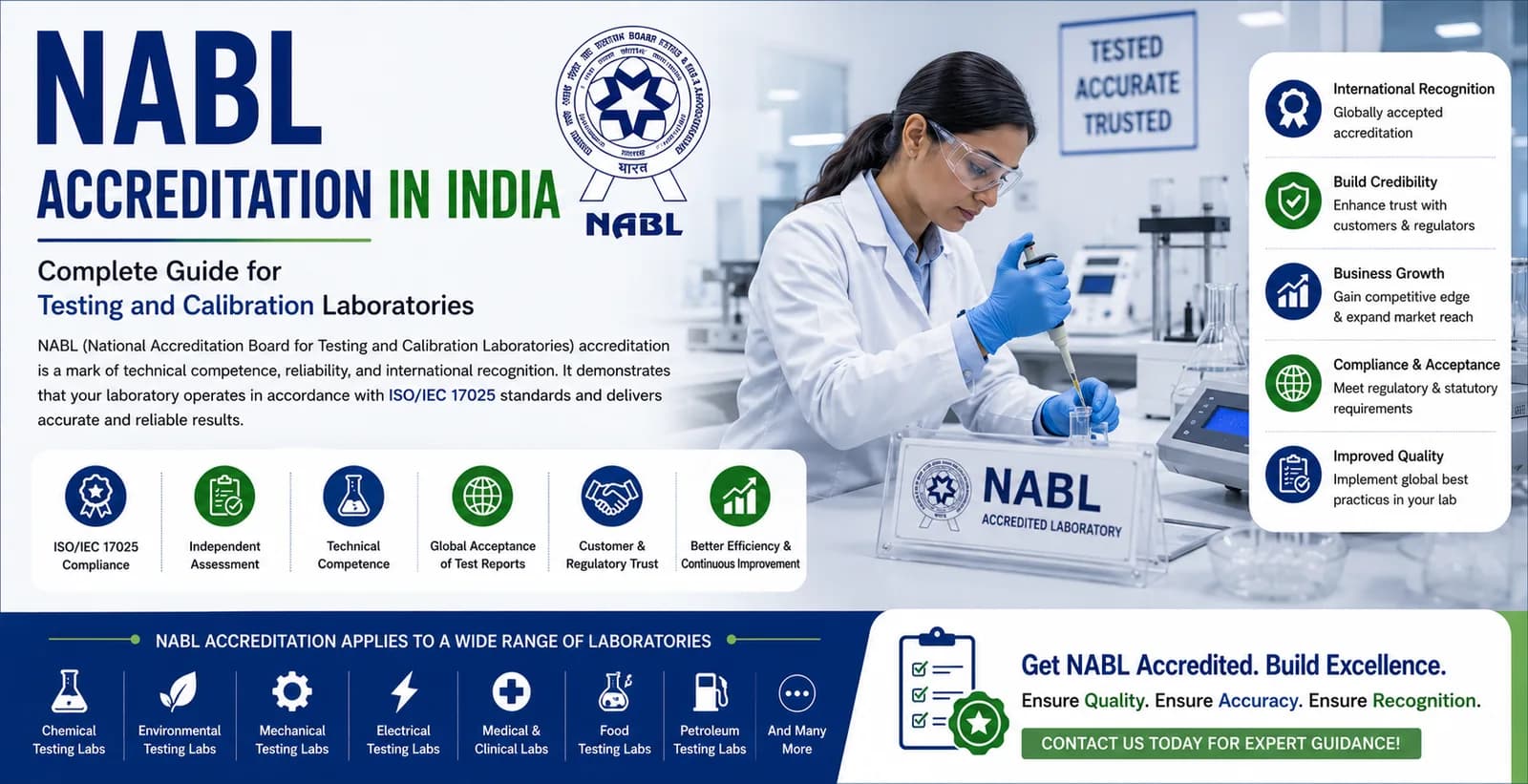
NABL Accreditation in India — Complete Guide for Testing and Calibration Laboratories
If you operate a testing or calibration laboratory in India — whether you test products for BIS certification, conduct environmental testing, perform food safety analysis, calibrate industrial instruments, or provide any other laboratory testing service — NABL Accreditation is the credential that separates recognised, trusted laboratories from the rest.
NABL — the National Accreditation Board for Testing and Calibration Laboratories — is India's apex accreditation body for testing and calibration laboratories. Operating under the Quality Council of India (QCI), NABL grants accreditation to laboratories that demonstrate technical competence and management system compliance with ISO/IEC 17025 — the international standard for laboratory competence.
At Ornate Quality Services, we help laboratories across India achieve and maintain NABL Accreditation — from initial gap assessment and ISO 17025 implementation to application management and assessment preparation. In this guide, we cover everything you need to know about NABL Accreditation — what it is, who needs it, how the process works, and what it costs.
Running a testing or calibration laboratory? Contact our team for a free NABL readiness assessment and find out what it takes to get accredited.
What is NABL Accreditation?
NABL — the National Accreditation Board for Testing and Calibration Laboratories — is the national accreditation body for testing and calibration laboratories in India. It is a constituent board of the Quality Council of India (QCI), operating under the Department for Promotion of Industry and Internal Trade (DPIIT), Ministry of Commerce and Industry.
NABL Accreditation is the formal recognition by NABL that a laboratory has demonstrated technical competence to perform specific tests or calibrations — as defined in its scope of accreditation — in accordance with the requirements of ISO/IEC 17025:2017, the internationally recognised standard for the competence of testing and calibration laboratories.
NABL is a signatory to the Mutual Recognition Arrangement (MRA) of the Asia Pacific Accreditation Cooperation (APAC) and the International Laboratory Accreditation Cooperation (ILAC). This means that NABL-accredited laboratory test reports are internationally recognised — accepted by regulatory authorities, government agencies, and international buyers in countries that are part of the ILAC MRA network.
NABL accreditation covers testing laboratories across all disciplines — mechanical, chemical, biological, electrical, electronics, fluid flow, photometry, and more — as well as calibration laboratories across all measurement parameters. Each laboratory's accreditation is specific to its defined scope.
Why NABL Accreditation Is Essential for Your Laboratory
NABL Accreditation transforms a laboratory from a testing facility into a recognised, trusted source of technically reliable data.
Required for BIS, FSSAI, CDSCO, and Other Regulatory Testing
Many of India's most important product certification schemes require testing at NABL-accredited laboratories. BIS CRS Registration requires testing at NABL-accredited labs. FSSAI food safety testing must be conducted at NABL-accredited food laboratories. CDSCO requires testing at NABL-accredited or internationally recognised labs. WPC requires RF testing at designated labs — typically NABL-accredited. Without NABL accreditation, a laboratory cannot participate in these high-value testing markets.
Government and Regulatory Acceptance
Government agencies, regulatory authorities, and public sector organisations increasingly require test reports from NABL-accredited laboratories for procurement qualification, environmental compliance, product approval, and enforcement purposes. BEE, CPCB, ARAI, and dozens of other agencies specify NABL accreditation as a requirement for accepted test reports.
International Acceptance of Test Reports
Through NABL's membership of the ILAC Mutual Recognition Arrangement, test reports issued by NABL-accredited laboratories carry international credibility. Indian exporters who need test reports accepted by overseas regulatory authorities can use NABL-accredited laboratory reports in many markets.
Competitive Advantage in Commercial Testing Market
In India's competitive commercial testing market, NABL accreditation is a significant differentiator. Manufacturers, importers, and exporters who need reliable test data prefer NABL-accredited laboratories because the accreditation provides independent assurance of technical competence.
Builds Internal Quality Culture
The process of achieving and maintaining NABL accreditation — implementing ISO 17025, establishing measurement uncertainty practices, maintaining equipment calibration, and running a systematic internal audit programme — creates a genuine quality culture within the laboratory that improves data reliability and reduces errors.
Types of NABL Accreditation — Which One Does Your Laboratory Need?
NABL offers accreditation across multiple laboratory disciplines. The following table covers the main types of NABL accreditation and the typical laboratory categories within each.
| Accreditation Type | Typical Laboratory Types | Common Test Parameters |
|---|---|---|
| Testing — Chemical | Chemical analysis labs, environmental labs, food labs, water testing labs | Heavy metals, pesticides, nutrients, contaminants, composition analysis |
| Testing — Biological | Microbiology labs, food safety labs, water quality labs, pharma labs | Microbial counts, pathogen detection, sterility testing, bioburden |
| Testing — Mechanical | Materials testing labs, structural testing, product safety labs | Tensile strength, hardness, impact, fatigue, dimensional testing |
| Testing — Electrical | Electronics testing labs, EMC labs, safety testing labs | Voltage, current, power, insulation resistance, dielectric strength |
| Testing — Electronics | BIS testing labs, RF labs, telecom labs, IT equipment labs | EMC, RF emissions, electrical safety, BIS CRS parameters |
| Testing — Fluid Flow | Flow measurement labs, hydraulic testing labs | Flow rate, pressure, viscosity, leak testing |
| Calibration — Dimensional | Dimensional calibration labs, metrology labs | Length, mass, angle, surface finish, form measurement |
| Calibration — Electrical | Electrical calibration labs, instrument calibration services | Voltage, current, resistance, frequency, power calibration |
| Calibration — Thermal | Temperature calibration labs, thermocouple calibration | Temperature, humidity, pressure calibration |
A laboratory can apply for NABL accreditation in multiple disciplines simultaneously — or build its scope progressively over time. Our team advises on the most strategic scope of accreditation based on the laboratory's current capabilities and target markets.
NABL Accreditation Process — Step by Step
The NABL accreditation process is structured around the requirements of ISO/IEC 17025:2017. It involves implementing the standard, applying to NABL, undergoing an assessment, and maintaining the accreditation through ongoing surveillance.
Step 1 — Gap Analysis Against ISO/IEC 17025:2017
The first step is understanding where your laboratory currently stands relative to ISO/IEC 17025:2017. A Gap Analysis identifies what is already in place and what needs to be developed before the NABL application is filed. Our team conducts a thorough Gap Analysis covering all clauses — from management system requirements and document control to equipment calibration, measurement uncertainty, proficiency testing, and method validation.
Step 2 — Quality Management System Documentation
ISO/IEC 17025:2017 requires laboratories to implement and document a management system covering all technical and administrative operations. Key documents include the Quality Manual, laboratory policies, standard operating procedures, equipment records, staff competency matrices, and internal audit procedures. Our team develops all required documentation tailored to your laboratory's specific scope, equipment, and operational practices.
Step 3 — Equipment Calibration & Traceability
ISO/IEC 17025 requires that all measurement equipment used in accredited testing or calibration is calibrated with traceability to national or international measurement standards. Our team helps you establish a complete equipment inventory, identify calibration requirements for each instrument, and develop a calibration schedule that meets ISO 17025 requirements.
Step 4 — Method Validation & Measurement Uncertainty
ISO/IEC 17025 requires laboratories to validate the test methods they use — demonstrating that methods are fit for purpose and produce reliable results. For calibration laboratories, estimating and documenting measurement uncertainty is a specific technical requirement. Our team provides expert guidance on validation approaches and uncertainty budgeting.
Step 5 — Proficiency Testing Participation
ISO/IEC 17025 and NABL requirements mandate that accredited laboratories participate in proficiency testing (PT) or interlaboratory comparison programmes. Laboratories must identify appropriate PT programmes for their scope and participate before and during the accreditation cycle. Our team identifies suitable programmes and helps interpret PT results including corrective action plans.
Step 6 — Internal Audit & Management Review
Before applying to NABL, the laboratory must complete at least one Internal Audit of its entire management system and conduct a Management Review with laboratory leadership. Our team trains your internal auditors, conducts the pre-application Internal Audit, and facilitates the Management Review — ensuring all findings are addressed before the NABL application is filed.
Step 7 — NABL Application Filing
The NABL application is filed online through the NABL portal. The application includes the laboratory's complete scope of accreditation, management system documentation, equipment lists, staff competency records, calibration certificates, proficiency testing records, and all supporting compliance documentation. Our team prepares and files the complete NABL application.
Step 8 — NABL Assessment & Accreditation
After application review, NABL assigns an assessment team consisting of a Lead Assessor and technical experts. The assessment involves a document review and an on-site visit to verify implementation. Non-conformities must be closed before accreditation is granted. Our team prepares your laboratory thoroughly for the NABL assessment and supports corrective action plans.
NABL Accreditation Requirements for Laboratories
Laboratories seeking NABL accreditation must meet the following requirements under ISO/IEC 17025:2017 and NABL's specific accreditation criteria.
Management System Requirements
- Documented management system covering all requirements of ISO/IEC 17025:2017
- Laboratory Quality Manual defining policies, objectives, and overall management framework
- Document control system for all laboratory procedures and records
- Internal audit programme — at least one complete internal audit before application
- Management review process with documented outcomes and improvement actions
- Corrective action system for addressing non-conformities and customer complaints
Technical Requirements
- Defined scope of accreditation — specific tests or calibrations with applicable methods and ranges
- Technically competent staff — qualifications, training records, and authorisation for all test activities
- Calibrated equipment with full traceability to national / international standards
- Validated test methods — including method validation records and measurement uncertainty estimates
- Appropriate laboratory facilities and environmental conditions for the scope of testing
- Proficiency testing participation — with satisfactory performance records
Infrastructure Requirements
The laboratory must have appropriate physical facilities — including controlled environmental conditions, adequate space for testing activities, and proper storage for samples and reference materials. For accreditation in specific disciplines, additional infrastructure requirements apply — for example, shielded rooms for EMC testing or cleanroom facilities for microbiology.
Not sure whether your laboratory meets NABL requirements? Our team provides a free readiness assessment covering all ISO 17025 requirements. Contact us to get started.
Documents Required for NABL Accreditation Application
The following documents are required for the NABL accreditation application. These form the core of the laboratory's quality management system documentation.
| No. | Document | Details |
|---|---|---|
| 1 | Quality Manual | Top-level document defining the laboratory's management system, scope, and policies |
| 2 | Standard Operating Procedures | Detailed procedures for all accredited tests and calibrations — method-specific |
| 3 | Equipment Calibration Records | Calibration certificates for all measurement equipment with traceability to national standards |
| 4 | Staff Competency Records | Qualifications, training records, and authorisation documentation for all technical staff |
| 5 | Method Validation Records | Validation data demonstrating fitness-for-purpose of all test methods in scope |
| 6 | Measurement Uncertainty Estimates | Documented uncertainty budgets for all calibration parameters (calibration labs) |
| 7 | Proficiency Testing Records | PT participation records with satisfactory performance results |
| 8 | Internal Audit Records | Internal audit plan, checklists, findings, and corrective action records |
| 9 | Management Review Records | Minutes and decisions from management review meeting |
| 10 | Scope of Accreditation Draft | Proposed scope listing specific tests / calibrations, methods, and measurement ranges |
Our team develops all required documentation during the implementation phase — ensuring your laboratory's quality management system is complete, technically sound, and assessment-ready before the NABL application is filed.
NABL Accreditation Cost in India
NABL accreditation costs include NABL application and assessment fees, proficiency testing charges, equipment calibration costs, and professional consulting fees.
NABL Application and Assessment Fees
NABL charges an application fee and assessment fees based on the laboratory's scope and size. Total NABL fees for the initial accreditation cycle typically range from INR 50,000 to INR 3,00,000 depending on the scope complexity and number of assessment days required.
Equipment Calibration Costs
Establishing a complete equipment calibration programme is a significant cost component. For a mid-sized testing laboratory, initial calibration costs can range from INR 1,00,000 to INR 5,00,000 depending on the number and type of instruments.
Proficiency Testing Fees
Participation in proficiency testing programmes involves fees paid to the PT provider — typically ranging from INR 5,000 to INR 30,000 per PT round per parameter. NABL requires participation in at least one PT round before accreditation for most test parameters.
Professional Consulting Fees
Ornate Quality Services charges a professional fee for the complete NABL accreditation consulting service — from Gap Analysis and ISO 17025 implementation to application filing, assessment preparation, and post-assessment non-conformity closure support. All fees are quoted transparently based on the laboratory's scope and size.
For a precise NABL accreditation cost estimate for your specific laboratory and scope — contact our team for a free consultation.
NABL Accreditation Validity and Surveillance Cycle
NABL accreditation is granted for a period of two years. The accreditation cycle consists of an initial accreditation assessment followed by annual surveillance assessments, and a full reassessment at the end of the two-year cycle.
Annual Surveillance Assessments
NABL conducts annual surveillance assessments during the accreditation cycle to verify that the laboratory continues to meet ISO/IEC 17025 requirements and maintains technical competence across its accredited scope. Surveillance assessments are typically shorter than initial assessments but cover all critical elements of the management system and selected technical activities.
Reassessment
At the end of the two-year accreditation cycle, a full reassessment is conducted. Successful reassessment results in renewal of accreditation for another two-year cycle. Our team manages the complete surveillance and reassessment cycle — ensuring your laboratory remains in a state of continuous assessment readiness.
Scope Extensions
Laboratories can extend their scope of accreditation at any time by applying for additional test parameters or calibration ranges. Scope extensions require a separate application and may involve an additional on-site assessment for the new parameters. Our team manages scope extension applications alongside ongoing accreditation maintenance.
Key Benefits of NABL Accreditation for Your Laboratory
- Regulatory acceptance — test reports accepted for BIS, FSSAI, CDSCO, WPC, BEE, and other regulatory certifications
- International recognition — ILAC MRA membership means NABL reports are accepted in 100+ countries
- Government contracts — eligibility for government, PSU, and institutional testing contracts requiring NABL accreditation
- Commercial credibility — NABL accreditation differentiates your laboratory in India's competitive testing market
- Higher fee realisation — accredited laboratories command better pricing than non-accredited competitors
- Technical improvement — ISO 17025 implementation genuinely improves data reliability and reduces errors
- Staff competency — structured training and authorisation systems build a more capable technical team
- Customer confidence — accreditation provides independent assurance of your laboratory's technical competence
- Export testing market — eligibility to perform export testing for manufacturers targeting international markets
Consequences of Operating Without NABL Accreditation
While operating a testing laboratory without NABL accreditation is not illegal in itself, the commercial and regulatory consequences of not being accredited are significant and increasingly limiting.
| Situation | Consequence Without NABL Accreditation |
|---|---|
| BIS CRS product testing | Test reports not accepted by BIS — product cannot be certified |
| FSSAI food safety testing | Reports not accepted for FSSAI compliance — food business cannot demonstrate compliance |
| Government tender qualification | Disqualified from tenders requiring NABL-accredited lab reports |
| Export testing for CE / FDA | Reports may not be accepted by overseas regulatory authorities |
| WPC RF testing | Designated lab status requires accreditation — not eligible without NABL |
As India's regulatory framework continues to strengthen — with BIS, FSSAI, CDSCO, and other agencies increasingly mandating NABL-accredited testing — the proportion of the testing market accessible to non-accredited laboratories will continue to shrink. NABL accreditation is a prerequisite for operating in the most significant segments of India's testing market.
Real Example — How We Helped a Hyderabad Electronics Testing Lab Achieve NABL Accreditation
A Hyderabad-based electronics testing laboratory approached Ornate Quality Services after failing its first NABL assessment attempt. The laboratory had been operational for four years and had submitted its NABL application based on a self-prepared quality management system — but the assessment had identified 14 non-conformities, including major non-conformities in method validation, measurement traceability, and proficiency testing.
The Challenge
The laboratory's self-prepared quality system documentation was technically incomplete — the SOPs lacked method validation data, the equipment calibration programme had gaps in traceability documentation, and the laboratory had not participated in proficiency testing before the assessment. NABL had placed the accreditation on hold pending closure of all non-conformities within 6 months.
What We Did
Our team conducted a detailed review of all 14 non-conformity reports and developed a structured corrective action plan. We rewrote the method validation documentation for all 12 test methods, established a complete equipment calibration programme, enrolled the laboratory in appropriate proficiency testing programmes, and revised the quality manual and SOPs. We also prepared the laboratory for a follow-up NABL assessment with a pre-assessment mock audit.
The Result
All 14 non-conformities were closed within the 6-month window. The follow-up NABL assessment found the laboratory fully compliant, and NABL accreditation was granted within 8 months of our engagement. The laboratory now holds accreditation for all 12 test parameters in its original scope and has since added 4 new parameters through scope extensions managed by our team.
Frequently Asked Questions — NABL Accreditation
ISO/IEC 17025 is the international standard for laboratory competence. NABL accreditation is the formal recognition granted by India's national accreditation body based on an assessment of whether the laboratory meets ISO 17025 requirements. ISO 17025 certification from a private certification body does not carry the same regulatory recognition or international standing. For regulatory purposes in India and for international MRA recognition, NABL accreditation is required.
Get Expert Assistance for NABL Accreditation
Need help with gap analysis, ISO 17025 implementation, NABL application filing, assessment preparation, or ongoing surveillance support? Connect with Ornate Quality Services for complete laboratory accreditation support.