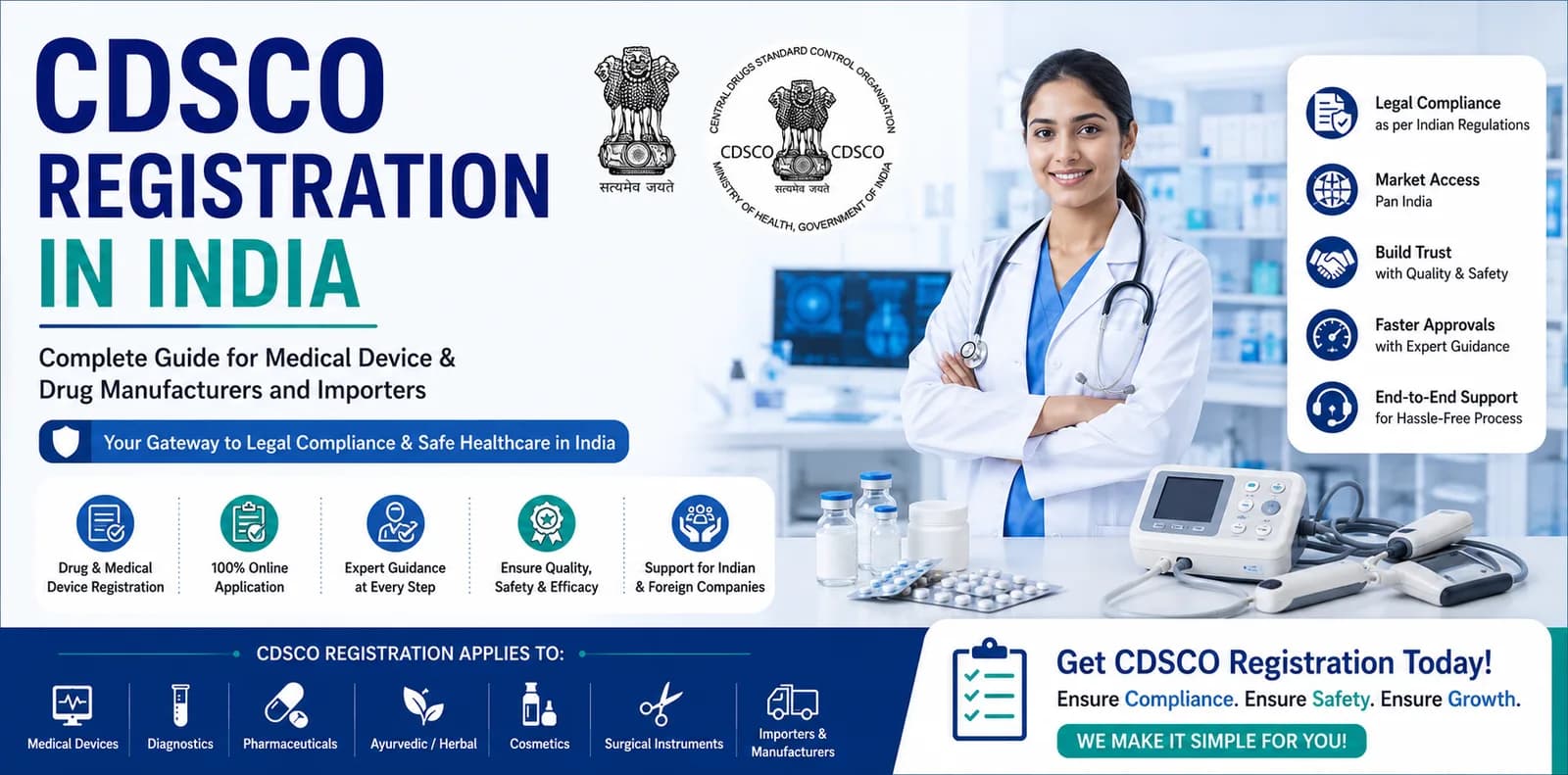
CDSCO Registration in India — Complete Guide for Medical Device & Drug Manufacturers and Importers
If you manufacture, import, or distribute medical devices, drugs, cosmetics, or diagnostics in India, CDSCO Registration is the central regulatory requirement that governs your entire market access. It is one of the most complex and consequential compliance processes in the Indian regulatory landscape — and one where the cost of getting it wrong goes well beyond financial penalties.
CDSCO — the Central Drugs Standard Control Organization — is India's national regulatory authority for pharmaceuticals, medical devices, cosmetics, and diagnostics. Operating under the Ministry of Health and Family Welfare, CDSCO is responsible for approving new drugs and medical devices, issuing import licences, regulating clinical trials, and enforcing standards for product safety and efficacy across India.
At Ornate Quality Services, we help medical device manufacturers, drug importers, cosmetic companies, and diagnostic device businesses navigate the CDSCO registration process — from initial product classification and regulatory pathway identification to complete application management and post-registration compliance. In this guide, we cover everything you need to know about CDSCO Registration in India.
Planning to import or manufacture medical devices or drugs in India? Contact our team for a free CDSCO consultation and get a clear regulatory roadmap for your product.
What is CDSCO Registration?
CDSCO — the Central Drugs Standard Control Organization — is the apex regulatory body for drugs, medical devices, cosmetics, and diagnostics in India. It functions under the Drugs and Cosmetics Act, 1940, and the Medical Devices Rules, 2017. CDSCO Registration is the formal approval or licence issued by CDSCO that permits a manufacturer or importer to legally sell or import regulated products in India.
The regulatory framework under CDSCO covers three main product categories — Drugs (including pharmaceuticals and biologicals), Medical Devices (from simple bandages to complex implantable devices), and Cosmetics. Each category has its own registration pathway, documentation requirements, and regulatory timeline.
For medical devices, India implemented a comprehensive regulatory framework under the Medical Devices Rules, 2017 — which classifies devices into four risk classes (Class A, B, C, D) and mandates registration for all devices. All medical devices sold in India must have a valid CDSCO registration by the dates specified in CDSCO's phased implementation schedule.
For drugs and pharmaceuticals, CDSCO issues import licences under Form 10 and manufacturing licences through the licensing system coordinated between CDSCO and State Drug Authorities. For cosmetics, import registration under CDSCO's Sugam portal is mandatory for all imported cosmetic products.
Why CDSCO Registration Is Essential for Your Business
CDSCO Registration is not a procedural formality — it is the gateway to one of India's most regulated and fastest-growing markets.
Mandatory for All Regulated Products
The Drugs and Cosmetics Act and the Medical Devices Rules make CDSCO registration mandatory for all covered product categories. Importing or selling drugs, medical devices, or cosmetics in India without valid CDSCO approval is a criminal offence — punishable with imprisonment and substantial fines.
India's Medical Device Market Is Growing Rapidly
India is one of the world's top 20 medical device markets and is growing at over 15% annually. CDSCO Registration is the gateway to this market — and businesses that get registered early build distribution relationships and brand recognition that are difficult for later entrants to displace.
Customs Clearance Requires It
Indian customs authorities check CDSCO registration for all regulated product categories at ports of entry. Medical devices, drugs, and cosmetics imported without valid CDSCO approval are refused clearance, held in bonded warehouses, or destroyed — often with catastrophic cost for temperature-sensitive products.
Hospital and Institutional Procurement Requires It
Hospitals, healthcare institutions, government medical procurement agencies, and pharmacy chains require valid CDSCO registration documentation before onboarding suppliers. GMSD and state medical supply corporations require CDSCO registration as a basic procurement eligibility criterion.
Patient Safety and Legal Liability
CDSCO registration requires manufacturers and importers to demonstrate that products are safe, effective, and manufactured to appropriate quality standards. Selling unregistered medical products in India carries significant legal liability in the event of adverse events or product failures.
Which Products Require CDSCO Registration in India?
CDSCO Registration covers three main product categories — Medical Devices, Drugs & Pharmaceuticals, and Cosmetics. Here is a breakdown of what falls under each category.
| Product Category | Common Products | Regulatory Route |
|---|---|---|
| Medical Devices — Class A (Low Risk) | Bandages, surgical gloves, tongue depressors, stethoscopes | Self-certification with CDSCO registration |
| Medical Devices — Class B (Low-Medium Risk) | Hypodermic needles, suction equipment, basic diagnostic devices | CDSCO registration with conformity certificate |
| Medical Devices — Class C (Medium-High Risk) | Haemodialysis machines, orthopaedic implants, ventilators | CDSCO registration with notified body certificate |
| Medical Devices — Class D (High Risk) | Active implantable devices, pacemakers, cardiac stents | Full CDSCO approval with clinical evidence |
| In-Vitro Diagnostics (IVD) | Blood glucose monitors, COVID test kits, biochemistry analysers | IVD-specific CDSCO registration pathway |
| Drugs & Pharmaceuticals | Prescription drugs, OTC medicines, APIs, biologicals | Form 10 import licence or manufacturing licence |
| Cosmetics (Imported) | Skincare, haircare, makeup, personal care products | Cosmetic registration on CDSCO Sugam portal |
| Software as Medical Device (SaMD) | Medical apps, AI diagnostics, clinical decision software | Risk-based classification under MDR 2017 |
Product classification under CDSCO is a critical first step — and incorrect classification is one of the most common reasons for application delays and rejections. Our team conducts a thorough product classification assessment before any application is filed, ensuring your product is correctly classified and the right regulatory pathway is selected.
CDSCO Registration Process — Step by Step
The CDSCO registration process varies significantly by product category and risk class. The following covers the core steps applicable to most medical device registrations — the most common CDSCO application type handled by Ornate Quality Services.
Step 1 — Product Classification & Regulatory Pathway Identification
The first step is correctly classifying your product under India's Medical Devices Rules, 2017 — determining whether it is Class A, B, C, or D, and identifying whether it is a medical device, IVD, cosmetic, or drug. This determines the entire regulatory pathway. Our team conducts a thorough product classification review based on intended use, mechanism of action, invasiveness, and duration of patient contact.
Step 2 — Appointment of Authorised Indian Representative (AIR)
Foreign manufacturers applying for CDSCO registration must appoint an Authorised Indian Representative (AIR) — a person or company based in India who acts as the official liaison between the manufacturer and CDSCO. Ornate Quality Services acts as the AIR for international medical device manufacturers — managing all CDSCO interactions, regulatory filings, and compliance obligations in India.
Step 3 — Technical Documentation Preparation
CDSCO registration requires comprehensive technical documentation demonstrating that the device is safe, effective, and manufactured to appropriate quality standards. The dossier includes product description, intended use, manufacturing process, risk management, performance testing, clinical evidence, labelling, and quality management system certification. Our team prepares the complete package tailored to your device's risk class.
Step 4 — Notified Body Certificate (Class B, C, D)
For Class B, C, and D medical devices, CDSCO requires a certificate from an internationally recognised Notified Body or recognised foreign regulatory authority. Accepted certificates include CE Marking under EU MDR, FDA 510(k) clearance or PMA approval, and certificates from other recognised authorities. Our team advises on which certificates are accepted for your device category.
Step 5 — CDSCO Sugam Portal Application Filing
All CDSCO applications are filed through the CDSCO Sugam portal. We create the applicant's portal account, prepare and upload all required documents in the correct format, complete the application form, and submit the application along with the prescribed fee. Our team manages the complete portal submission and resolves technical issues that arise during filing.
Step 6 — CDSCO Technical Review & Query Resolution
CDSCO's technical reviewers examine the submitted application and documentation. The review timeline varies by device class — from a few weeks for Class A to several months for Class C or D devices. CDSCO may raise technical queries requiring additional information. Our team monitors application status and responds to all queries promptly and comprehensively.
Step 7 — Grant of CDSCO Registration Certificate
Upon satisfactory completion of the technical review, CDSCO issues the Registration Certificate or Import Licence for the device. The certificate specifies the device name, manufacturer details, product description, and validity period. For imported devices, the certificate is required for customs clearance of all commercial shipments.
Step 8 — Post-Market Surveillance & Renewal
CDSCO registration is not a one-time process. Registered manufacturers and importers must maintain post-market surveillance systems, report adverse events to CDSCO through the Vigilance and Risk Assessment cell, and renew registration before expiry. Our team manages the complete post-registration compliance programme.
CDSCO Registration Requirements for Manufacturers and Importers
The requirements for CDSCO registration vary by product category and risk class. The following covers the key requirements for medical device registration — the most common CDSCO application type.
For Foreign Manufacturers — Medical Devices
- Valid manufacturing authorisation from the regulatory authority of the country of manufacture
- ISO 13485 Quality Management System certification — mandatory for Class B, C, D devices
- CE Marking, FDA approval, or equivalent recognised international certification for Class B and above
- Appointment of an Authorised Indian Representative with a valid address in India
- Complete technical documentation as per CDSCO's requirements for the applicable device class
- Post-market surveillance system capable of reporting adverse events to CDSCO
For Indian Manufacturers — Medical Devices
- Valid manufacturing licence from the State Drug Authority for the manufacturing premises
- ISO 13485 certification (mandatory for Class B, C, D devices)
- Technical documentation demonstrating device safety and performance
- Ability to conduct post-market surveillance and adverse event reporting
For Drug Importers
- Valid import licence under Form 10 from CDSCO — required before first shipment
- Certificate of Pharmaceutical Product (CoPP) from the regulatory authority of the country of manufacture
- Good Manufacturing Practice (GMP) compliance certificate from the manufacturer
- Approved product dossier including drug master file data where applicable
Not sure which CDSCO pathway applies to your product? Our team provides a free regulatory assessment. Contact us before you begin documentation preparation.
Documents Required for CDSCO Registration
The following documents form the core of a CDSCO medical device registration application. Requirements vary by device class — documents marked in details as Class B, C, D are required for those device classes.
| No. | Document | Details |
|---|---|---|
| 1 | Manufacturing Authorisation Certificate | Licence from the regulatory authority of the country of manufacture confirming GMP compliance |
| 2 | ISO 13485 Certificate | Quality Management System certificate from an accredited certification body (Class B, C, D) |
| 3 | CE / FDA / Equivalent Certificate | International regulatory certificate accepted by CDSCO for the device category (Class B, C, D) |
| 4 | Product Technical File | Complete technical documentation covering device description, specifications, and performance data |
| 5 | Risk Management Documentation | ISO 14971 risk management file covering all identified hazards and risk controls (Class B, C, D) |
| 6 | Clinical Evidence | Clinical evaluation report or clinical trial data demonstrating device safety and performance (Class B, C, D) |
| 7 | Instructions for Use (IFU) | Complete instructions for use in English — and other Indian languages as required |
| 8 | AIR Appointment Letter | Signed appointment letter for the Authorised Indian Representative |
| 9 | Labelling Samples | Proposed Indian market labelling showing all mandatory declarations |
| 10 | Free Sale Certificate | Certificate confirming the device is freely sold in the country of manufacture |
Our team provides a precise, device-specific document checklist after reviewing your product classification and existing regulatory certifications. We identify documentation gaps early and advise on the most efficient way to address them.
CDSCO Registration Cost in India
CDSCO registration costs vary significantly by product category, device class, and the complexity of the technical documentation required.
CDSCO Government Fee
CDSCO charges a government fee at the time of application filing. For Class A devices, fees are typically INR 5,000 to INR 10,000. For Class B, C, and D devices, fees range from INR 10,000 to INR 50,000 depending on the device category and number of models covered.
ISO 13485 Certification Cost
For Class B, C, and D devices, ISO 13485 certification from an accredited certification body is a prerequisite. If the manufacturer does not hold ISO 13485, this must be obtained before the CDSCO application can be filed.
Technical Documentation Preparation
Preparing a CDSCO-compliant technical dossier — particularly for Class C and D devices — requires regulatory expertise. Ornate Quality Services charges a professional fee for complete technical documentation preparation, regulatory strategy, application filing, and query resolution — quoted based on device class and complexity.
Authorised Indian Representative Service
Ornate Quality Services charges an annual fee for acting as the Authorised Indian Representative for foreign medical device manufacturers. As your AIR, we manage all CDSCO correspondence, adverse event reporting, and regulatory compliance obligations in India on your behalf.
For a precise CDSCO registration cost estimate for your specific device and regulatory situation — contact our team for a free consultation.
CDSCO Registration Validity and Renewal
CDSCO medical device registrations are typically granted for a period of 5 years. Import licences for drugs are issued for varying periods depending on the product category. The exact validity is specified on the registration certificate at the time of issue.
Renewal Process
CDSCO registration renewal must be applied for before the current registration expires. The renewal process involves filing a renewal application on the Sugam portal with updated documents and confirmation that the device continues to meet all applicable requirements. For devices where specifications or manufacturing have changed, updated documentation must be submitted.
Post-Market Surveillance Requirements
Throughout the validity period, registered manufacturers and importers must maintain an active post-market surveillance system — monitoring device performance, collecting adverse event reports, and filing periodic safety update reports with CDSCO where required.
Change Notifications
Any significant change to the device — including design modifications, manufacturing changes, or labelling updates — must be notified to CDSCO. Depending on the nature of the change, CDSCO may require a supplementary application or amendment to the existing registration. Our team advises on when changes trigger a notification requirement and manages the process.
Key Benefits of CDSCO Registration for Medical Device Businesses
- Legal market access — sell medical devices, drugs, and cosmetics in India without risk of seizure or enforcement
- Customs clearance — CDSCO-registered products clear Indian customs without regulatory holds
- Hospital procurement — supply to hospitals, government medical stores, and healthcare institutions
- GeM portal — required for supplying medical devices to government healthcare buyers
- E-commerce — list medical devices on Amazon India, Flipkart Health, and other online health platforms
- Distributor onboarding — meet mandatory compliance requirements of national medical device distributors
- Patient safety — CDSCO registration confirms your device has been assessed for safety and performance
- Brand credibility — CDSCO registration signals regulatory compliance to healthcare professionals and institutional buyers
- International credibility — CDSCO registration supports market access applications in other South Asian markets
Penalties for Selling Medical Devices Without CDSCO Registration
The Drugs and Cosmetics Act and the Medical Devices Rules prescribe serious penalties for manufacturing, importing, or selling regulated products without valid CDSCO registration. Enforcement has strengthened significantly since the full implementation of the Medical Devices Rules in 2022.
| Violation | Consequence |
|---|---|
| Importing medical devices without CDSCO registration | Shipment seized at customs — refused clearance or destroyed |
| Manufacturing or selling unregistered medical devices | Imprisonment up to 3 years and/or fine under Drugs and Cosmetics Act |
| Selling substandard or adulterated medical products | Imprisonment up to life in cases involving serious harm or death |
| Failure to report adverse events to CDSCO | Regulatory action including suspension or cancellation of registration |
| Non-compliant labelling or false claims | Product recall, seizure, and penalties under D&C Act |
CDSCO and State Drug Authorities conduct joint enforcement operations — including surprise inspections of hospitals, pharmacies, and medical device distributors. Products found without valid registration documents are seized immediately.
Real Example — How We Helped a South Korean Medical Device Manufacturer Get CDSCO Registered
A South Korean manufacturer of Class B in-vitro diagnostic devices — specifically point-of-care blood glucose monitoring systems — approached Ornate Quality Services after their Indian distributor informed them that their devices were being flagged during hospital audits for missing CDSCO registration. Their products had been sold in India for two years through informal channels without registration.
The Challenge
The manufacturer held CE Marking for their devices under the EU IVDR, but their Indian distributor had been selling the products without a valid CDSCO registration — under the mistaken belief that CE Marking alone was sufficient for the Indian market. When CDSCO's phased implementation schedule extended mandatory registration to their device category, the distributor began receiving compliance notices.
What We Did
Our team conducted a full regulatory assessment of the manufacturer's device portfolio — covering three blood glucose monitor models and a range of test strips. We confirmed the correct device classification, verified that the EU IVDR certificate was accepted by CDSCO, and appointed Ornate as the Authorised Indian Representative. We prepared the complete technical dossier, filed CDSCO Sugam applications in parallel, and responded to CDSCO's technical queries within the required timeframe.
The Result
CDSCO registrations were obtained for all three device models within 4 months. The distributor resolved the hospital compliance notices, and the manufacturer's products are now legally registered and available through organised hospital procurement channels across India. The manufacturer maintains an ongoing compliance programme through our AIR service.
Frequently Asked Questions — CDSCO Registration
No. CE Marking is accepted by CDSCO as supporting evidence for Class B, C, and D device registrations — but it does not replace CDSCO registration. Every medical device sold in India must have a valid CDSCO registration certificate, regardless of international certifications. CE Marking makes the CDSCO registration process faster and easier — but it is not a substitute for it.
Get Expert Assistance for CDSCO Registration
Need help with product classification, AIR appointment, technical dossier preparation, Sugam portal filing, or post-market surveillance? Connect with Ornate Quality Services for complete support.