
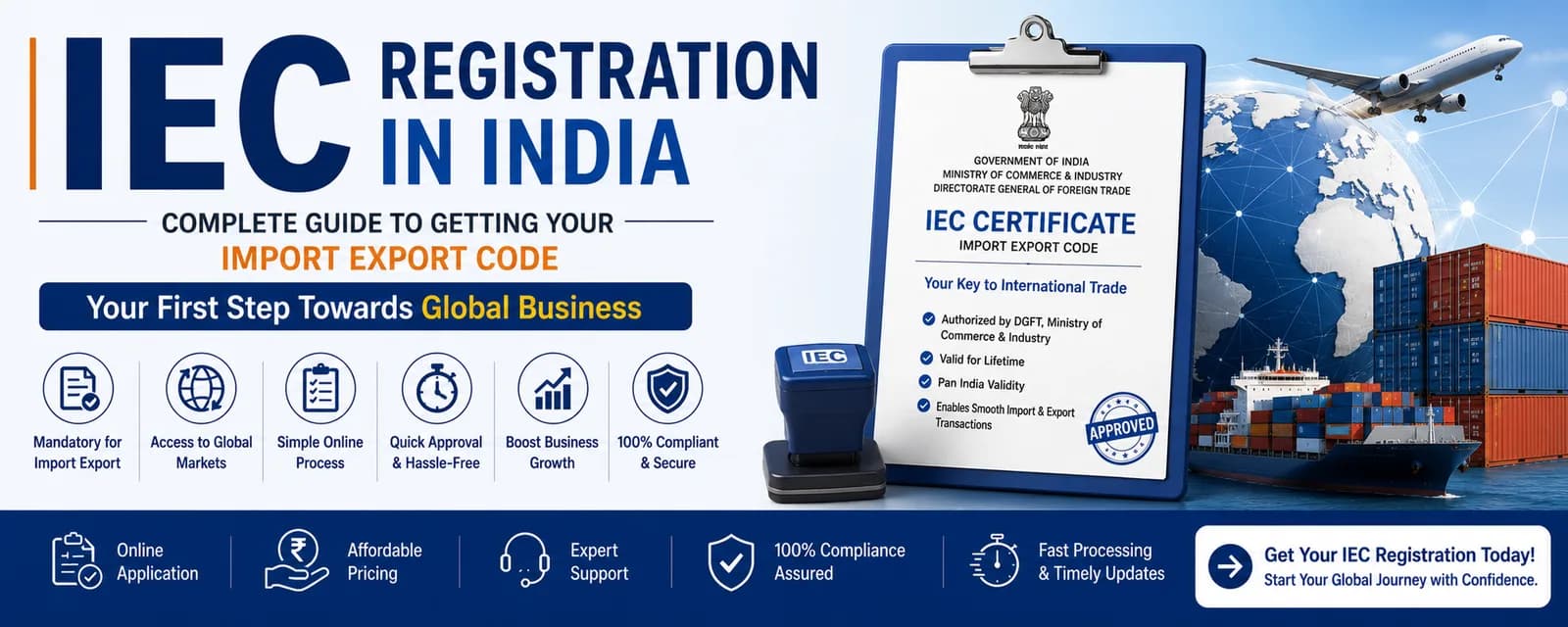
IEC Registration in India — Complete Guide to Getting Your Import Export Code
If you want to import or export goods from India — whether you are a manufacturer looking to sell overseas, a trader sourcing products internationally, or a startup entering the global market — the Import Export Code, commonly known as IEC, is the first compliance step you need to take.
IEC is a 10-digit unique identification code issued by the Directorate General of Foreign Trade (DGFT) under the Ministry of Commerce and Industry. It is mandatory for any individual or business entity engaged in the import or export of goods and services from India. Without a valid IEC, customs will not clear your shipment — either incoming or outgoing.
At Ornate Quality Services, we have been helping importers, exporters, manufacturers, and traders obtain their IEC registration quickly and correctly since 2013. In this guide, we cover everything you need to know — what IEC is, who needs it, how to get it, what it costs, and how to keep it updated.
Ready to start importing or exporting? Contact our team for a free IEC consultation and get your code within days.
What is Import Export Code (IEC) Registration?
Import Export Code (IEC) is a mandatory 10-digit business identification number issued by DGFT — the Directorate General of Foreign Trade — to any individual or business entity that wants to import goods into India or export goods from India. The code is linked to your PAN and serves as your identity in all international trade transactions.
IEC is issued under the Foreign Trade (Development and Regulation) Act, 1992, and is governed by the Foreign Trade Policy of India. Every importer and exporter must quote their IEC in all customs documentation, bank remittances for international payments, and DGFT filings related to foreign trade.
The IEC is a lifetime registration — once issued, it does not expire as long as it is kept updated annually on the DGFT portal. It is required for customs clearance, opening a foreign currency account, receiving foreign remittances for export proceeds, and accessing various government export incentive schemes.
Importantly, IEC is required for the import of goods even if the importer does not intend to sell those goods commercially — including products imported for personal use in commercial quantities or for product certification purposes such as BIS testing.
Why IEC Registration Is Essential for Your Business
IEC is not just a compliance formality — it is the foundational legal identity for any business engaged in international trade in India. Here is why getting your IEC right matters.
Mandatory for All Import and Export Activity
The Foreign Trade Policy of India makes IEC mandatory for every entity engaged in the import or export of goods. Customs authorities require a valid IEC for clearance of all commercial shipments. Without IEC, your goods will be held at customs and cannot be cleared for entry into or exit from India.
Required for All Downstream Compliance
IEC is a prerequisite for virtually every other import-related compliance registration in India. LMPC Registration requires IEC. EPR Registration for importers requires IEC. GeM seller registration for importers requires IEC. WPC ETA applications for importers require IEC. Getting your IEC sorted first saves time and avoids delays down the line.
Access to Export Incentive Schemes
The Government of India offers export incentive schemes — including RoDTEP, MEIS successor schemes, and duty drawback benefits. All of these require a valid IEC as the foundational registration. Exporters without IEC cannot access any government export incentives.
Foreign Currency Transactions and Bank Remittances
Banks in India require a valid IEC for processing foreign currency transactions related to international trade — including advance payments for imports, export proceeds, and trade finance facilities. Without IEC, your bank cannot process international trade remittances.
Business Credibility with International Partners
For international buyers, suppliers, and business partners, IEC registration is a basic signal that your business is legally authorised to engage in international trade in India. Providing your IEC number in trade correspondence and contracts demonstrates regulatory compliance and builds confidence with foreign counterparts.
Who Needs IEC Registration in India?
IEC is required for a wide range of business activities involving cross-border trade. The following table provides a clear breakdown of who needs IEC registration and for what purpose.
| Business Type | Activity | IEC Required? |
|---|---|---|
| Manufacturer | Importing raw materials, components, or machinery from overseas | Yes — mandatory |
| Importer / Trader | Importing finished goods for sale in India | Yes — mandatory |
| Exporter | Exporting goods manufactured or sourced in India to overseas buyers | Yes — mandatory |
| E-Commerce Seller | Selling products to overseas buyers through platforms like Amazon Global | Yes — required for cross-border e-commerce |
| Service Exporter | Providing services to overseas clients with foreign currency remittances | Yes — required for most service exports |
| Startup / New Business | Planning to import components or export products in the future | Yes — get IEC before first shipment |
| Individual Entrepreneur | Importing or exporting goods in personal or business capacity | Yes — IEC can be issued to individuals |
| MSME | Importing machinery, exporting handicrafts, textiles, or manufactured goods | Yes — mandatory regardless of size |
There are limited exemptions from IEC — including imports and exports by the Central Government, certain categories of personal baggage, and imports for personal use not exceeding prescribed limits. For any commercial import or export activity, IEC is mandatory without exception.
IEC Registration Process — Step by Step
IEC registration is processed entirely online through the DGFT portal. Here is a complete breakdown of every step and how Ornate Quality Services manages the process for you.
Step 1 — PAN Verification & Eligibility Check
IEC is issued against the applicant's PAN. The first step is verifying that the PAN is active, correctly linked to the applicant's current address and bank account details, and that there are no existing IEC registrations against the same PAN. Our team verifies all PAN-linked details before beginning the application.
Step 2 — Document Preparation
We prepare the complete IEC application documentation including identity and address proof, business registration documents, bank account details, and digital photograph. Our team verifies that the name and address on the PAN, bank account, and business registration documents match exactly before filing.
Step 3 — DGFT Portal Registration & Application Filing
The IEC application is filed on the DGFT portal at dgft.gov.in. We create the applicant's DGFT portal account, complete the application form, upload supporting documents, and submit with government fee payment using DSC or Aadhaar-based OTP authentication as applicable.
Step 4 — Application Review & IEC Issuance
DGFT processes IEC applications automatically for most straightforward cases where documents are consistent. In such cases, the IEC is issued digitally within 24 to 48 hours. For applications requiring manual review, our team monitors status and responds to DGFT queries promptly.
Step 5 — IEC Certificate Download & Verification
Once issued, we download and provide the official IEC certificate and verify all details — IEC number, entity name, address, and PAN — before handing it over. The IEC number should be shared with your customs broker, bank, and all relevant parties immediately after issuance.
Step 6 — Annual IEC Update on DGFT Portal
DGFT requires all IEC holders to update their IEC profile every financial year between April and June. IECs not updated within the prescribed period are marked inactive. Our team sends annual update reminders and manages the renewal process to keep your IEC active.
IEC Registration Eligibility and Requirements
IEC can be obtained by any Indian individual or business entity engaged in import or export activity. The following eligibility requirements apply.
For Sole Proprietors and Individuals
- Valid individual PAN card
- Aadhaar card linked to the applicant's mobile number — for OTP-based authentication
- Active bank account in the applicant's name — savings or current account
- Address proof — Aadhaar, passport, voter ID, or utility bill
- Passport-size photograph of the applicant
For Private Limited Companies, LLPs, and Partnerships
- Company PAN card
- Certificate of Incorporation or LLP Agreement or Partnership Deed
- Registered office address proof — rental agreement or utility bill
- Active current account in the company name
- Digital Signature Certificate (DSC) of the authorised signatory
- Board Resolution or authorisation letter for the applicant signatory
For Trusts, Societies, and Other Entities
Trusts, registered societies, government undertakings, and other entities can also obtain IEC with appropriate registration documents and governing body resolutions. Our team advises on the specific requirements for non-standard entity types.
Not sure which documents apply to your business type? Our team provides a precise document checklist after a quick initial review. Contact us before you begin gathering documents.
Documents Required for IEC Registration
The following documents are required for IEC registration on the DGFT portal. Requirements vary by entity type.
| No. | Document | Proprietor / Individual | Company / LLP |
|---|---|---|---|
| 1 | PAN Card | Individual PAN | Company PAN |
| 2 | Aadhaar Card | Mandatory — OTP auth | Authorised signatory's Aadhaar |
| 3 | Address Proof | Aadhaar / Passport / Utility Bill | Registered office address proof |
| 4 | Business Registration | Shop Act / GST Certificate | Certificate of Incorporation / LLP Agreement |
| 5 | Bank Account Details | Cancelled cheque / bank certificate | Cancelled cheque in company name |
| 6 | Photograph | Passport-size photograph | Passport-size photo of signatory |
| 7 | Digital Signature | Not required for individual | DSC of authorised signatory |
| 8 | Authorisation | Not applicable | Board Resolution / authorisation letter |
All documents must be in the same name and address as the PAN and bank account. Discrepancies between documents are the most common cause of IEC application rejection. Our team verifies all documents for consistency before filing.
IEC Registration Cost in India
IEC registration is one of the most affordable regulatory registrations in India. Here is a complete breakdown of the costs involved.
DGFT Government Fee
The government fee for IEC registration is INR 500 — paid online at the time of application filing on the DGFT portal. This is a one-time fee. There is no annual renewal fee for IEC — only the free annual update on the DGFT portal is required each year.
Digital Signature Certificate (DSC) — If Required
Companies and LLPs applying for IEC need a valid Digital Signature Certificate for the authorised signatory. DSC costs typically range from INR 1,000 to INR 2,500 depending on the class and validity period required.
Professional Service Fees
Ornate Quality Services charges a professional fee for end-to-end IEC registration management — from document review and DGFT portal filing to certificate delivery and annual update management. Our fees are transparent, fixed, and significantly lower than the cost of dealing with portal rejections.
IEC registration is one of the most affordable compliance steps your business will ever take — and one of the most impactful. Contact us for a free consultation and we will get it done for you quickly.
IEC Validity and Annual Update Requirements
IEC is a lifetime registration — it does not expire as long as it is updated annually on the DGFT portal. This makes IEC fundamentally different from most other business registrations, which require periodic renewal with fees.
Annual Update — April to June Every Year
DGFT requires all IEC holders to log in to the DGFT portal and confirm or update their IEC profile details every financial year between April 1 and June 30. IECs that are not updated within this window are marked as inactive by DGFT. An inactive IEC cannot be used for customs clearance, bank remittances, or any other trade purpose until it is reactivated.
Updating IEC Details After Changes
Any change to the IEC holder's business details — including address, bank account, mobile number, or entity name — must be updated on the DGFT portal. Changes must be made promptly to avoid discrepancies with customs documentation and bank records.
Key Benefits of IEC Registration
- Legal authorisation — import and export goods legally with customs clearance from day one
- Prerequisite for downstream compliance — LMPC, EPR, WPC, GeM, and other registrations require valid IEC
- Export incentives — access to RoDTEP, duty drawback, and other government export benefit schemes
- Foreign currency transactions — enable international payments through Indian banks without compliance issues
- Global market access — establish legal credibility with international buyers, suppliers, and trade partners
- No renewal fee — lifetime registration with only a free annual update required
- Fast issuance — straightforward applications approved within 24 to 48 hours
- Cross-border e-commerce — required for selling on Amazon Global, Flipkart Global, and other export platforms
- Trade finance access — enables letter of credit, export financing, and other trade finance facilities from banks
Consequences of Importing or Exporting Without IEC
Attempting to import or export goods without a valid IEC is a violation of the Foreign Trade (Development and Regulation) Act. The consequences are immediate and operational — not just financial.
| Violation | Consequence |
|---|---|
| Importing without IEC | Shipment held at customs — not cleared until IEC is provided |
| Exporting without IEC | Export shipment blocked at port — cannot be processed by customs |
| Using incorrect or fraudulent IEC | Seizure of goods and legal proceedings under Foreign Trade Act |
| Inactive IEC used for customs clearance | Shipment flagged and held — IEC must be reactivated before clearance |
| Failure to update IEC annually | IEC becomes inactive — blocks all import and export activity until updated |
The most common consequence of IEC non-compliance is operational — a shipment held at customs at the worst possible time. The cost of customs storage, demurrage, and delayed delivery almost always exceeds the cost of getting IEC registered in advance. Our team ensures your IEC is in place before your first shipment, and stays active and updated throughout your business lifecycle.
Real Example — How We Helped a First-Time Importer Get IEC and Start Operations in 3 Days
A young entrepreneur from Bengaluru was setting up an import business for consumer electronics accessories — primarily wireless earbuds and phone cases sourced from suppliers in China and Vietnam. She had placed her first order and confirmed a shipment date with her supplier before realising that she did not have an IEC and that her shipment could not be cleared at customs without one.
The Challenge
With the shipment already in transit and an estimated arrival date at the Nhava Sheva port in 12 days, she needed her IEC urgently. She had attempted self-registration on the DGFT portal but the application was rejected because the address on her PAN did not match the address on her GST certificate.
What We Did
Our team immediately identified the PAN-GST address discrepancy and guided her through the GST address correction process — processed within 2 working days. Once the addresses were consistent, we prepared her complete IEC application documentation, filed it on the DGFT portal, and managed Aadhaar OTP authentication.
The Result
The IEC was issued within 48 hours of application filing — 9 days before her shipment arrived at the port. She was also advised to begin LMPC Registration for her product range in parallel, which Ornate completed before her second shipment arrived. She now runs a fully compliant import operation.
Frequently Asked Questions — IEC Registration
IEC is not required for imports of goods for personal use — items imported for individual personal consumption and not for commercial sale. However, customs authorities determine personal use based on quantity, value, and nature of goods. For any import in commercial quantities — even for testing or certification — IEC is required.
Get Expert Assistance for IEC Registration
Need help with IEC registration, DGFT portal filing, or annual IEC updates? Connect with Ornate Quality Services for complete support and professional guidance for your import-export business.